Boyd Exell Chases History in Bordeaux: Opening Round of the Driving World Cup™ Final
Saturday night in Bordeaux is already defined by prime-time Jumping, but once the final oxer has been cleared and the arena lights reset, a second headline act takes over. At 23:00, the first leg of the Opening Competition of the FEI Driving World Cup™ Final by Laiterie de Montaigu begins, carrying Bordeaux deep into championship sport and giving the weekend a rhythm few indoor venues attempt.
It is an unusual slot, and that is precisely what makes Bordeaux different. Rather than isolating disciplines across separate days, the Jumping International de Bordeaux stacks elite competition into a single evening, creating something closer to a stadium double-header than a traditional horse show programme. For driving, it means performing in front of an audience already fully engaged, warmed up by World Cup Jumping leg, and willing to stay late for a championship finale in the making.
Can Boyd Exell Extend the Record Yet Again?
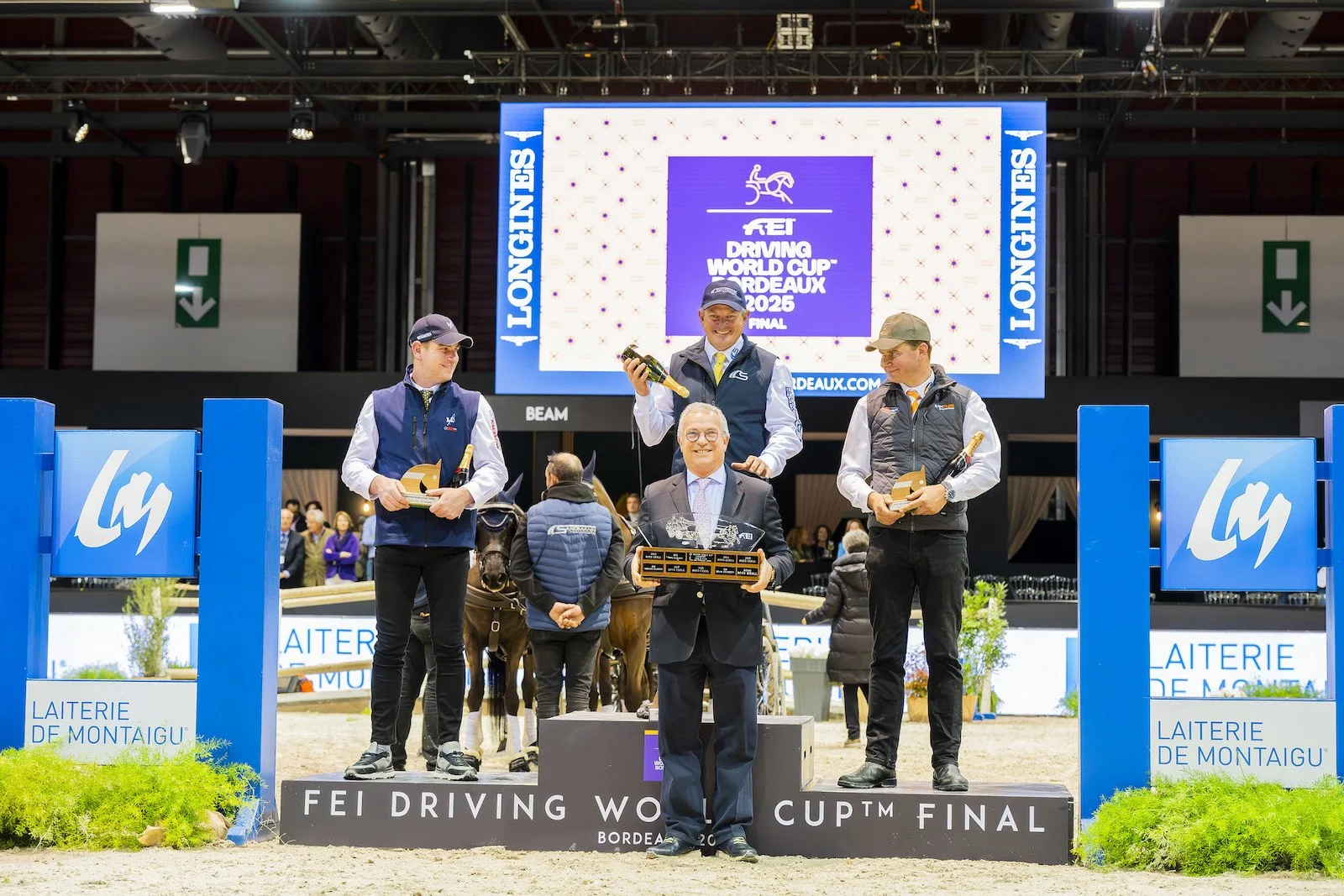
Podium of the FEI Driving World Cup Final Season 2024/2025: Second place Dries Degrieck (BEL), World Cup winner Boyd Exell (AUS), third place Koos de Ronde (NED). Image: ©FEI/Lukasz Kowalski
At the centre of that storyline stands Boyd Exell. Arriving in Bordeaux as defending champion, Exell already holds an extraordinary 11 FEI Driving World Cup Final titles. This weekend, he is chasing a potential twelfth - a milestone that pushes the narrative well beyond equestrian circles and into mainstream sporting territory. Champion versus history is a story anyone can understand, and Bordeaux provides the perfect coliseum for it.
What makes this pursuit particularly compelling is not just the number, but the consistency behind it. Exell has defined the modern era of indoor Driving, combining precision, speed and tactical clarity in a discipline where margins are measured in tenths of seconds and millimetres at the cones. His dominance has been built over seasons, not streaks, and Bordeaux represents another opportunity to extend a record that already feels almost untouchable. Yet this is not a coronation event. The field itself is tightly curated: Six qualified drivers, four former champions and two runners-up. There are no development entries here, no outsiders making up the numbers. Every competitor arrives with genuine podium credentials, which gives Saturday night’s opening competition real weight. The first leg is not a formality; it is the foundation on which Sunday’s title will be built.
For Exell, that means managing pressure as much as performance. Unlike Jumping’s single-class climax, Driving unfolds episodically, so a clean opening round matters to limit mistakes carried forward. And Saturday’s results will shape every strategic decision that follows.
A Late-Night Crowd-Pleasing Spectacle
The timing of Bordeaux’s Driving opener is more than a scheduling quirk. Competing at 23:00 places athletes into a very specific atmosphere: A crowd that has already experienced hours of elite sport, an arena charged with energy, and a setting that rewards composure under fatigue as much as technical execution. The crowds of Bordeaux are known for their engagement, and that intensity does not fade as the evening progresses. For drivers, it creates a unique environment, one where focus must be absolute, and communication between driver and team must cut through noise, lights and the audience’s enthusiasm for adrenaline.
Saturday night in Bordeaux very much feels like the opening chapter of a championship series, played out in front of a full house that understands it is witnessing something decisive. It also reinforces Bordeaux’s wider identity: This is no longer a single-discipline stop on a crowded calendar. With jumping in prime time, dressage newly added to the programme, and the pinnacle of the season for the four-in-hand driving, Bordeaux is actively positioning itself as a multi-sport equestrian weekend, where the FEI disciplines share the same spotlight, rather than competing for it.
A Championship Line-Up and Margins Measured in Mili-Seconds
This year’s FEI Driving World Cup™ Final by Laiterie de Montaigu opening competition brings together one of the most competitive shortlists of the indoor season, and the margins could scarcely be tighter heading into Saturday night.
Alongside Boyd Exell, the line-up includes Belgium’s Dries Degrieck, who arrives in Bordeaux having edged his way into the Final through consistently narrow qualification results. Degrieck’s presence adds a compelling challenger narrative: a driver whose recent form has been defined by fine margins, incremental gains and growing confidence on the indoor circuit. He joins a field that blends proven champions with drivers still chasing their defining World Cup moment, including Ijsbrand Chardon, Bram Chardon, Jérôme Voutaz, Christoph Sandmann and Benjamin Aillaud.
Fractions of a second regularly separate podium positions at this level, and cone penalties or a single hesitation in the marathon-style phases can reshape the leaderboard entirely. With only six drivers in the Final, there is nowhere to hide, as every round counts, and every decision carries weight into Sunday’s final.
For seasoned finalists, Bordeaux is about execution. They understand the rhythm of the weekend, the pressure of the cones phase, and the importance of building momentum across two competitions. For others, Saturday represents a chance to disrupt the narrative, to challenge Exell’s dominance and force the championship into open territory.
For the chasing pack, Saturday’s opening competition represents both opportunity and risk. A strong start will put immediate pressure on Exell, whilst a mistake hands momentum straight back to the defending champion. It is this compressed, high-stakes format that makes Bordeaux such a compelling Driving venue, turning the opening competition into a genuine pressure test rather than a gentle warm-up.
Editorially, that balance mirrors what is unfolding in Jumping earlier the same evening. Established names defend ground, while challengers look for breakthroughs. The difference is that driving compresses its drama into a two-day window: Saturday sets the order, Sunday delivers the verdict.