
The presidential election will take the headlines. The votes that will affect most people's sport are the other ones.
The FEI General Assembly in Jiangyin, running from 2 to 5 December, will vote on the 2027 budget and on proposed modifications to the FEI Rules and Regulations. The Board approved the agenda, the budget and the proposed modifications to the General Regulations and Veterinary Regulations before sending them forward.
All annexes were published on 6 November on the General Assembly's dedicated hub, which means everything below is now in the public domain and available to anybody who wants to read it.
The Four Full Revisions
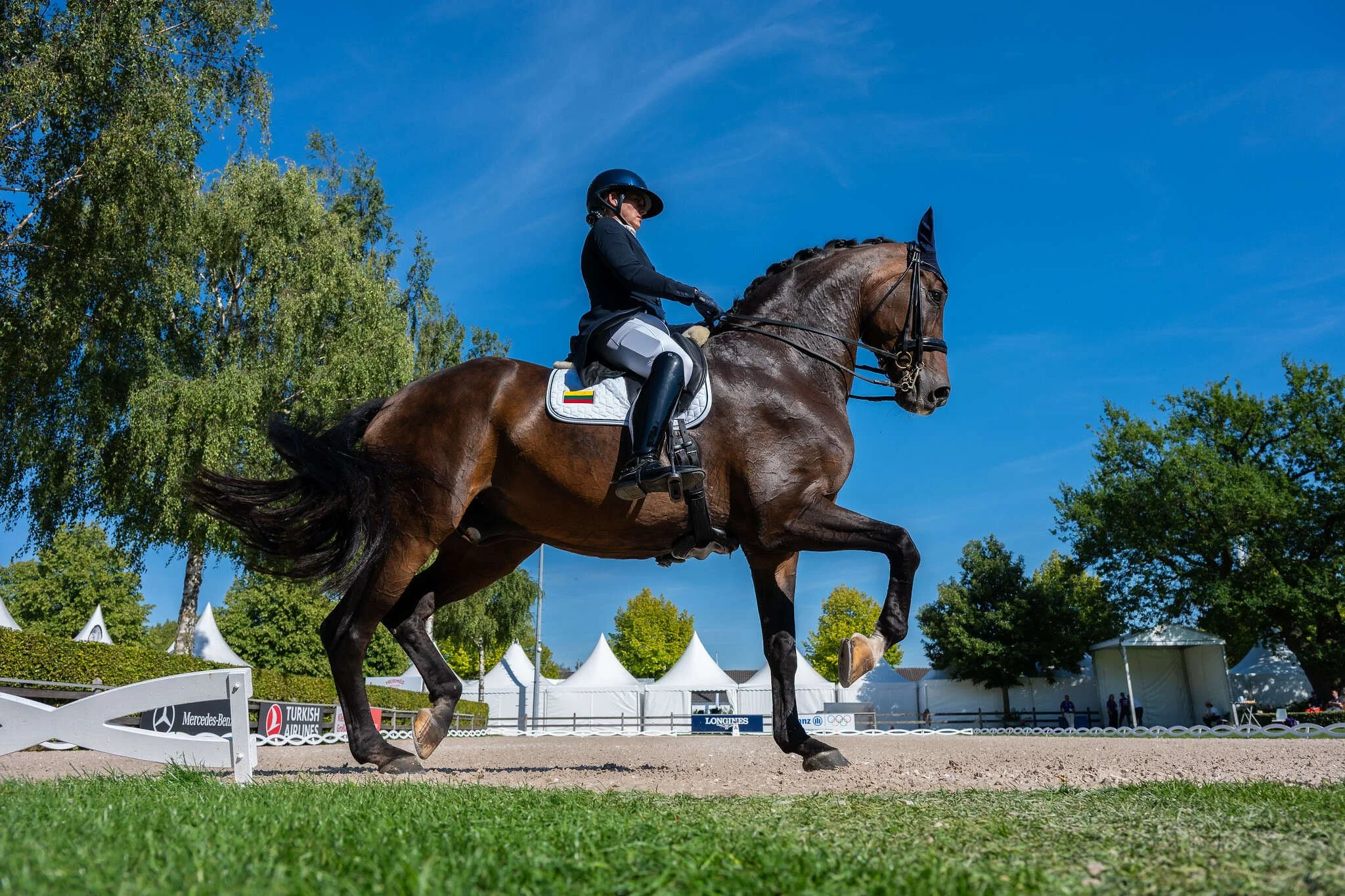
Justina VANAGAITE-SAMUILE [LTU] and Nabab at the FEI World Championships 2026, Aachen. Image: © FEI/Łukasz Kowalsk
Four rule sets underwent a complete revision in 2026 rather than the usual partial amendment:
The FEI Veterinary Regulations
The FEI Dressage Rules
The FEI Para Dressage Rules
The FEI Vaulting Rules
Alongside them, the FEI Anti-Doping Rules for Human Athletes are also under full revision, and the FEI Regulations for Equestrian Events at the Olympic and Paralympic Games Los Angeles 2028 are on the agenda for discussion.
The FEI operates a rolling revision cycle in which each discipline's rules are fully reopened periodically rather than continuously amended. Jumping, Eventing, and Driving and Para Driving had their full revision in 2025, taking effect on 1 January 2026, with the Jumping Rules additionally restructured and modernised. Dressage's turn is now.
The Dressage Consultation, and Its Roadmap
The dressage process is the one to follow most closely, because it is the discipline under most public pressure and because the consultation has been unusually structured.
The published roadmap ran as follows. Rule change proposals from the Dressage Technical Committee and working groups were submitted by 1 March 2026. The Sports Forum in Lausanne held a dedicated rules session. Draft regulations were published on 20 July. Stakeholder and National Federation review ran from July until the deadline of 7 September. Proposed final versions were published on 6 November, ahead of the General Assembly vote.
The substance under review goes well beyond tidying. It includes the degree of difficulty in freestyles, the judging guidelines and the firewalls between judges, and a formal review of the recommendations made by the 2018 Dressage Judges Working Group, several of which have never been implemented. The FEI dressage tests at all levels are to be updated or revised with effect from January 2027, and there is a proposal for a judge to participate in press conferences.
That last item is small and significant. Dressage judging is the most contested element of any Olympic equestrian discipline, and requiring a judge to explain scores publicly would be a meaningful change in accountability.
The work also sits explicitly alongside the Equine Ethics and Wellbeing Action Plan and the Ethical Training Working Group, which is the FEI acknowledging that dressage's rules problem and its welfare problem are the same problem.
What Already Changed This Year
For context, the rules that took effect on 1 January 2026, approved at the previous General Assembly, included several that have shaped the season just finished.
In eventing dressage, at CCI4* championships and above, a variance of three points or more between two judges on a flying change, halt, rein-back or walk pirouette now triggers a review of the official video as soon as possible after the test.
In the veterinary regulations, intrasynovial and intratendinous or ligamentous administration of any medication became a prohibited method during FEI events. Injection or infusion of vitamins or minerals during events is prohibited unless in an emergency under Veterinary Form A. Access to FEI stables is restricted to equidae, dogs and humans.
And the rule that attracted most attention outside the sport: using any substance such as shaving cream around a horse's mouth to imitate foaming now carries a Yellow Warning Card and elimination.
The direction of travel is consistent. The FEI is writing rules against practices that look bad on video, because video is now the medium in which the sport is judged by people who do not ride.
More on the 2026 FEI Election: FEI Presidential Election 2026: The Candidates and the Process. Learn how the election rules work, who makes up the electorate, and the key governance challenges awaiting Ingmar De Vos’s successor in Jiangyin.