
Buried in the FEI Board's governance decisions this year is a line that matters more than its phrasing suggests.
The Board approved the establishment of a task force, under the working heading Rules Revision: Horse Condition Harmonisation, to review the various rule proposals relating to horse condition, covering horse welfare and abuse of horse, with the stated aim of finding multidisciplinary consensus.
Why It Exists
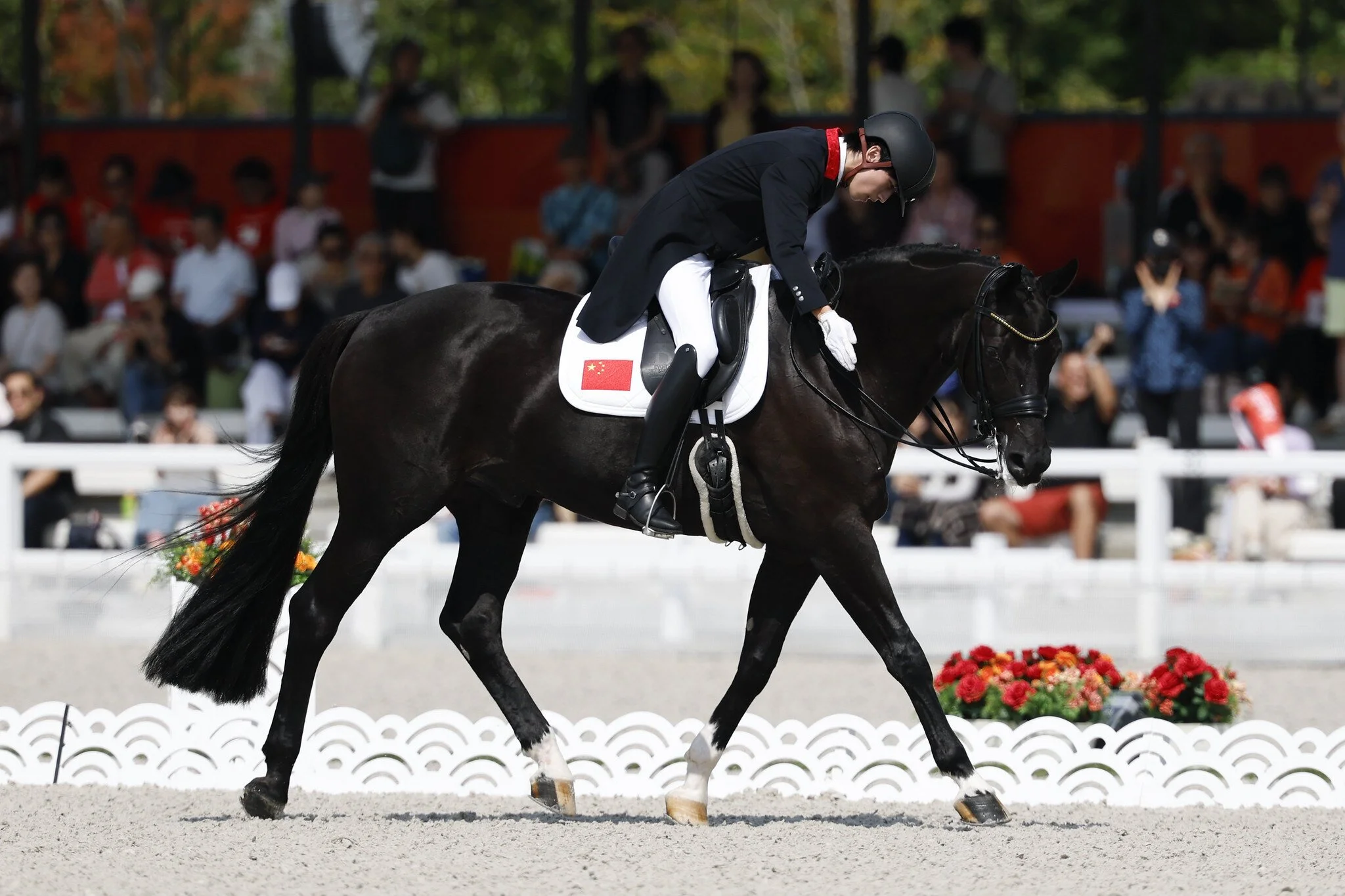
GU Zhanzhao (CHN) and SHAKESPEARE 82 during the 20th Asian Game Aichi-Nagoya 2026. Image: © FEI/Yusuke Nakanishi
Every FEI discipline has its own rules on what constitutes abuse of horse, what triggers elimination, and what penalties apply. They were written separately, at different times, by different technical committees, for sports with genuinely different demands.
The result is incoherence. Blood in a dressage test, blood on a cross-country round, and blood in a jumping arena are dealt with differently, as they probably should be, but the differences have never been reconciled against a single welfare standard. A steward moving between disciplines applies different thresholds. A journalist comparing two eliminations finds no consistent logic. A member of the public watching a clip finds none at all.
The task force's job is to produce consensus across disciplines on what horse condition rules should say. The terms of reference and composition were due to go to the Board at its summer meeting.
Why It Is Hard
Harmonisation sounds obviously desirable and is genuinely difficult, for two reasons.
The first is technical. Cross-country is an endurance test over fixed obstacles at speed. Grand Prix dressage is a test of collection in a twenty by sixty arena. The physical demands, the risk profiles and the ways in which a horse can be compromised are not the same, and a rule written to be uniform across both will be either too loose for one or too strict for the other.
The second is political. Any harmonisation exercise in a federation with multiple discipline committees tends toward the standard that the most permissive discipline can accept, because that is where consensus lies. The alternative, harmonising upward, imposes costs on disciplines that did not ask for them and will be resisted by the committees representing them.
The FEI has set itself the harder version of the task by seeking multidisciplinary consensus rather than imposing a standard. Whether that produces a coherent welfare framework or a negotiated minimum is the thing to watch over the next two years.
The Context It Sits In
This is not an isolated initiative. The Sports Forum in Lausanne this spring carried a full session on the veterinary regulations revision, covering among other things mandatory overnight stable closure for a minimum period, and safety concerns around bicycles and electric scooters in stable areas.
It also sits alongside the Judge Monitoring Programme, the Equine Ethics and Wellbeing Action Plan, the Ethical Training Working Group, and the dressage rules revision going to Jiangyin.
Read together, these are not separate workstreams. They are one project, which is the FEI attempting to build a defensible, consistent, publicly explicable account of what the sport permits and what it does not, before someone outside the sport builds one for it.
The new President, whoever that is, inherits the task force and its output. None of the three manifestos can plausibly avoid the subject, and the Meet the Candidates session in September will have put it to all of them.
What each of them thinks harmonisation should mean in practice is the question that matters. The answer separates a candidate with a welfare position from a candidate with a welfare vocabulary.