
Spectators were in the grandstands with blankets long before the first horse went to the start on Saturday morning, staking out seats for a competition that has been the emotional centre of the Spruce Meadows Masters since 1977. What they watched was a German team that had won the world championship four weeks earlier doing much the same thing again, and a Leopoldo Palacios course doing a great deal of damage to everybody else.
Germany won the 2026 BMO Nations' Cup on four penalties, a twelfth victory in the competition and a record. Ireland took second on 17, having climbed from fourth after the opening round, while Belgium came third on 21 from fifth at halfway, and Great Britain finished fourth on 26. The United States, fourth after round one, slipped to fifth on 46 without managing a fault-free trip all afternoon, with France, Sweden, the Netherlands and host nation Canada completing the nine.
Otto Becker's Squad, Barely Troubled
Germany arrived with Daniel Deusser, Sophie Hinners, Jörne Sprehe and Richard Vogel under chef d'équipe Otto Becker, three of them fresh from the team that won gold at the World Championships in Aachen in August [LINK anchor: "won gold at the World Championships in Aachen" → Aachen jumping team final report], and they proceeded to make a difficult afternoon look considerably more straightforward than it was.
Three of the four German riders went round the 1.60m track without fault, leaving a total that nobody else could realistically approach, and Sophie Hinners with Iron Dames My Prins produced the only double clear of the entire competition across both rounds. It took eighteen trips before the first double clear of the day appeared at all, which says more about the course than any description could. Vogel and Cloudio, for their part, were among the few to master the BMO triple combination, the question that unpicked almost everyone else.
The Triple That Decided It
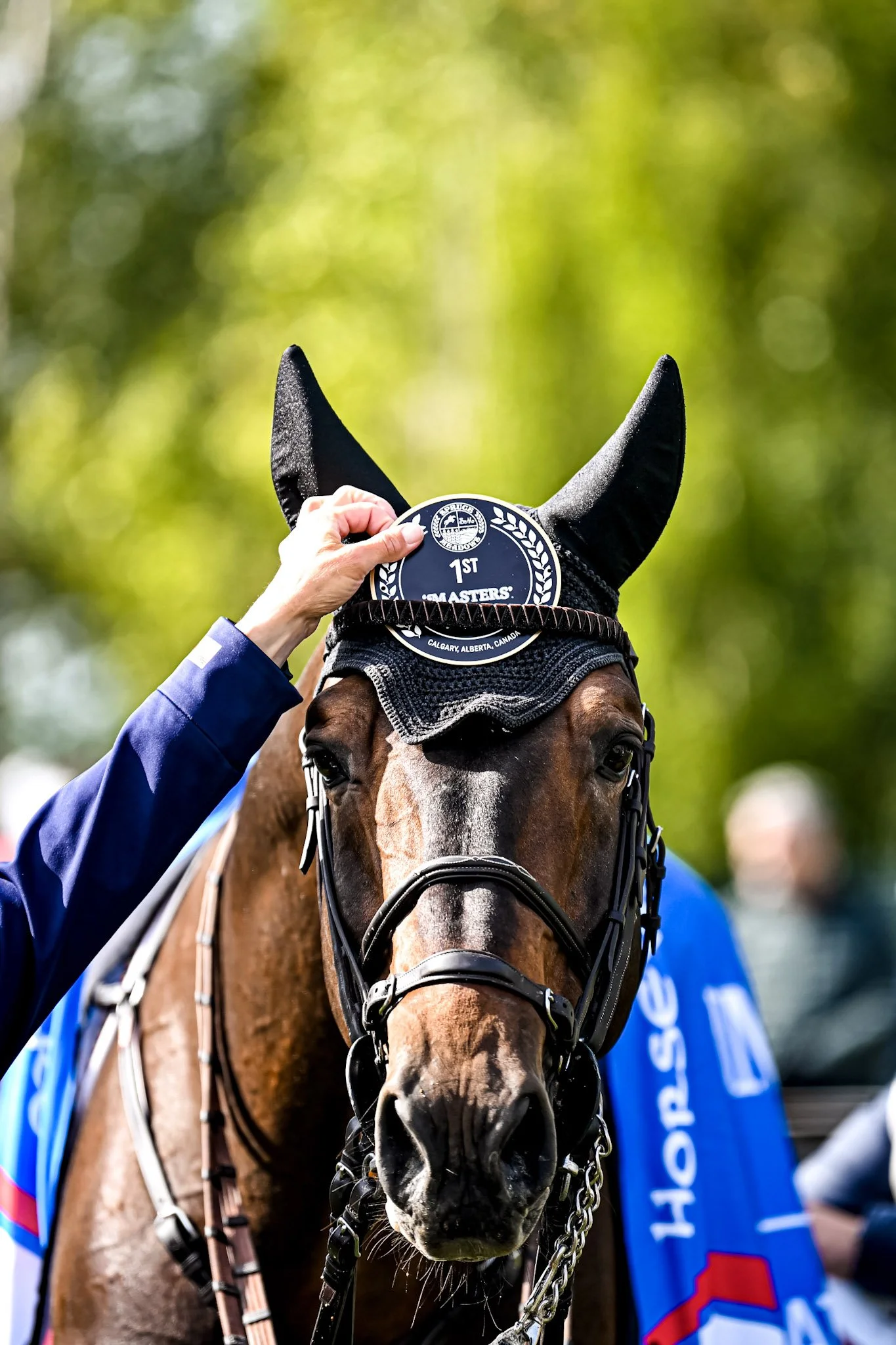
“Toys” ridden by Jörne Sprehe, winners of the CSIO Spruce Meadows 'Masters', BMO Nations' Cup, 2026. Image: © M. Froment for EQuerry Co
Palacios has been building at Spruce Meadows for years and his 1.60m track was technical rather than simply large, demanding precision, strategy and consistency over three rounds rather than raw scope, with every rail carrying weight.
The triple combination became the afternoon's defining obstacle, and Ian Millar, the ten-time Canadian Olympian now serving as chef d'équipe to the United States, was refreshingly direct about it afterwards, conceding that it had not been his team's best day and observing that the BMO triple had caused what he judged to be an unintended amount of trouble. His anchor rider McLain Ward did not jump in the second round at all, since nothing he could have produced would have improved the American placing, a notable decision. A chef d'équipe quietly withdrawing a four-time Olympic medallist from a second round at a five-star Nations Cup, on the straightforward grounds that there is no longer anything to be gained from running the horse, is horse management conducted in public at one of the sport's largest events, and the sport could do with more of it.
How the Format Works
For anyone who finds Nations Cup scoring opaque, the BMO runs it in the classic form, with each of the nine nations fielding four riders selected by their national federation and the best three scores counting towards a first-round total. The top six teams then return in reverse order of standing to jump an identical course a second time, with the best three scores again added to the running total, and a jump-off between single nominated riders settling any tie for first.
That structure, with no reduction in team size between rounds, explains why the leaderboard moved as much as it did. Ireland climbed two places, Belgium two, the United States dropped one, and only Germany, sitting on four faults throughout, was never at any point in difficulty.
Four Decades of Sponsorship, and Fifteen Thousand Volunteer Hours
The BMO Nations' Cup has been part of the Masters since 1977 and for much of its history was the only outdoor show jumping Nations Cup anywhere in North America, a distinction the venue has never been shy about.
June Zimmer, Regional President, Private Wealth at BMO, framed the bank's continued involvement around exactly that longevity, calling the competition a highlight of the Masters for more than four decades and thanking Spruce Meadows, the Southern family, the athletes, the volunteers and the fans. The mention of the volunteers was well placed. Their contribution at Spruce Meadows runs to 15,718 hours in a year, equivalent to 7.56 full-time jobs and valued by the venue's own analysis at $608,267. The full economic picture is worth a look [LINK anchor: "The full economic picture is worth a look" → Spruce Meadows economic impact feature].
The View from Britain
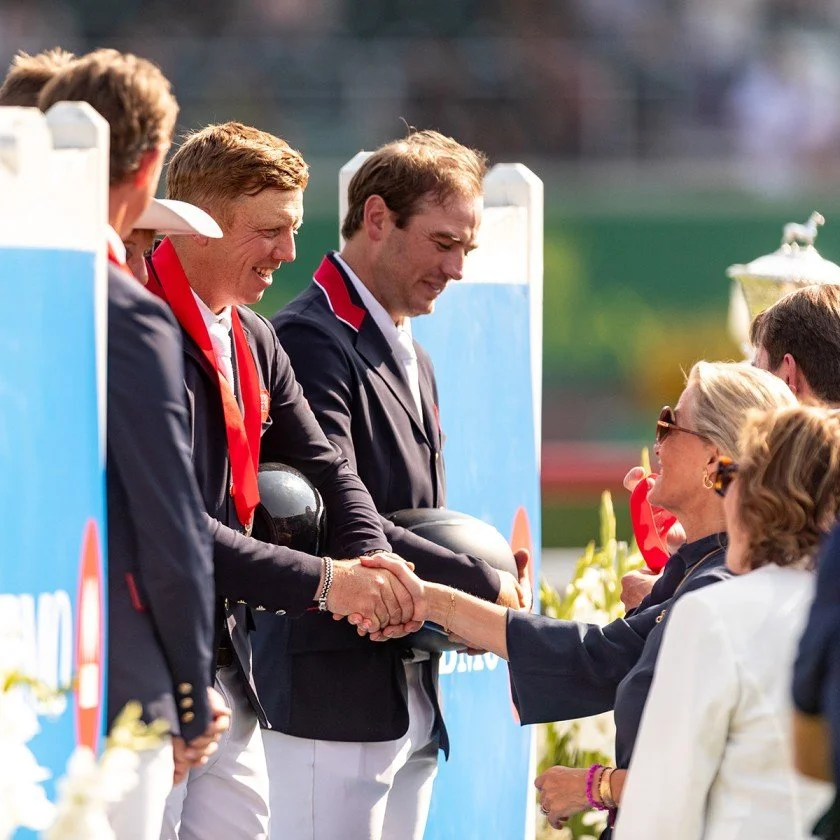
Team Great Britain celebrated victory in the 2025 BMO Nations’ Cup in front of Her Highness the Duchess of Edinburgh. Image: © Spruce Meadows Media/Mark Spowart
Fourth place on 26 penalties, behind Germany, Ireland and Belgium, is a respectable rather than memorable afternoon for a British side that had taken world championship team bronze at Aachen in August and won the Longines League of Nations leg at Rotterdam in June.
It also completed a particular kind of symmetry. Germany beat Britain into third at the World Championships, into fourth here in Calgary, and then took the Longines League of Nations title in a Barcelona jump-off three weeks later [LINK anchor: "took the Longines League of Nations title in a Barcelona jump-off" → LLN Final Barcelona report]. Whatever else 2026 turns out to have been, it was Germany's year in team jumping, and Saturday afternoon in the foothills was the clearest single demonstration of it.