
Fifty combinations came forward on the historic grass arena for the Rolex Grand Prix presented by Agria, and the one who left with it had never won a Rolex Series Grand Prix before. Shane Sweetnam and James Kann Cruz took the fourth leg of the 2026 Series, with Richard Vogel second and Steve Guerdat third.
The format is unusual for anyone used to jump-off Grands Prix. Falsterbo runs its Rolex class over two rounds against the clock, with the leading 25%, or every clear round, whichever is greater, going through to round two. Penalties from both rounds are aggregated, and the second-round time settles the order. It rewards consistency across two efforts rather than one fast burst, which is why the result reads as a horse-and-rider result rather than a speed result.
Frank Rothenberger's first-round course had 14 obstacles and 17 efforts, and it went to work on the entry list quickly. Mexico's Luis Alejandro Plascencia opened with a clear that set the standard, then the leaderboard began to tell a different story: Martin Fuchs and Conner Jei on four, world number one Kent Farrington and Greya also on four, Pieter Devos and Casual DV Z on twelve, and home favourite Henrik von Eckermann retiring.
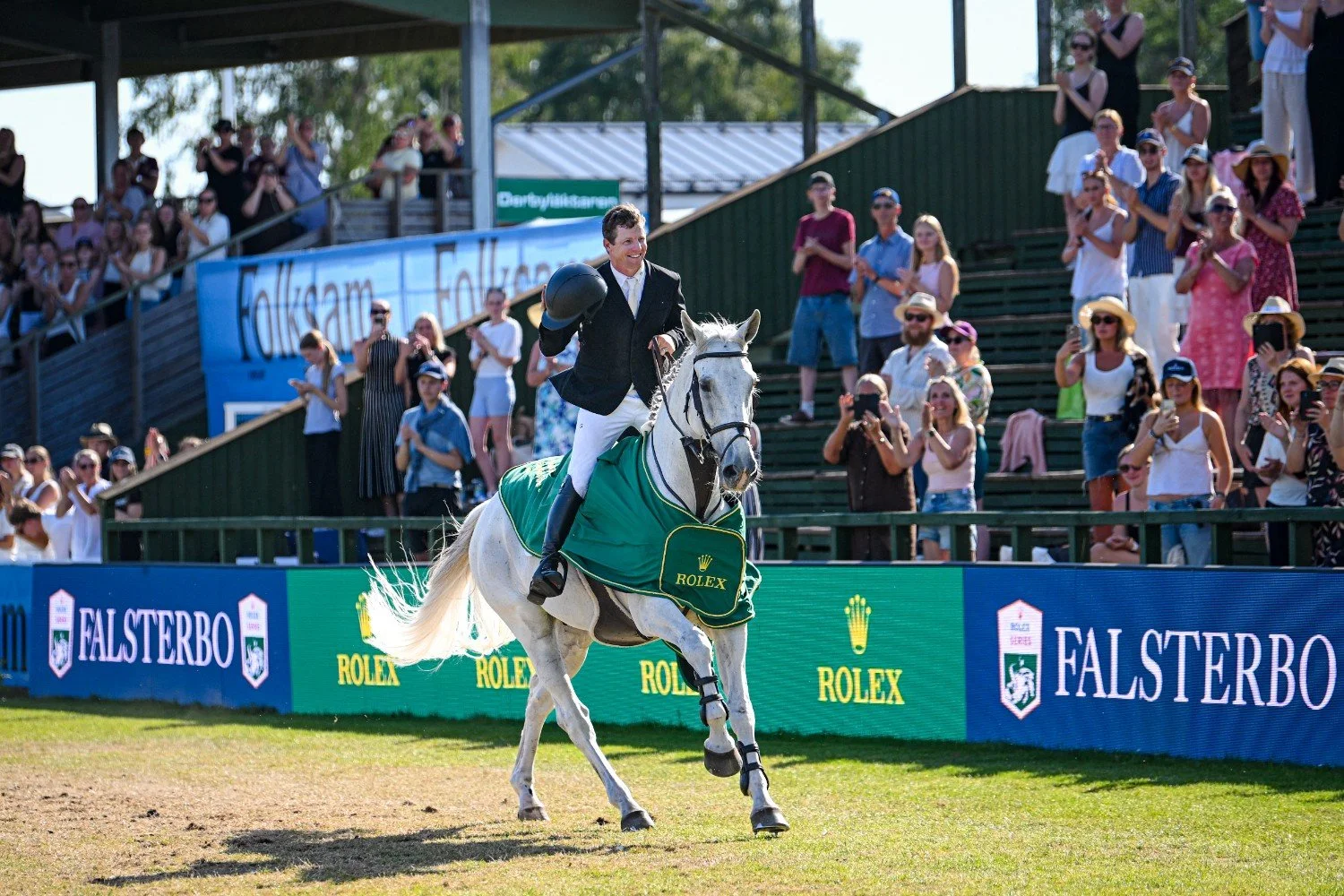
Shane Sweetnam and James Kann Cruz winners of the CSI5* Rolex Grand Prix presented by Agria at the Falsterbo Horse Show. Photo: ©M. Froment for Equerry Co.
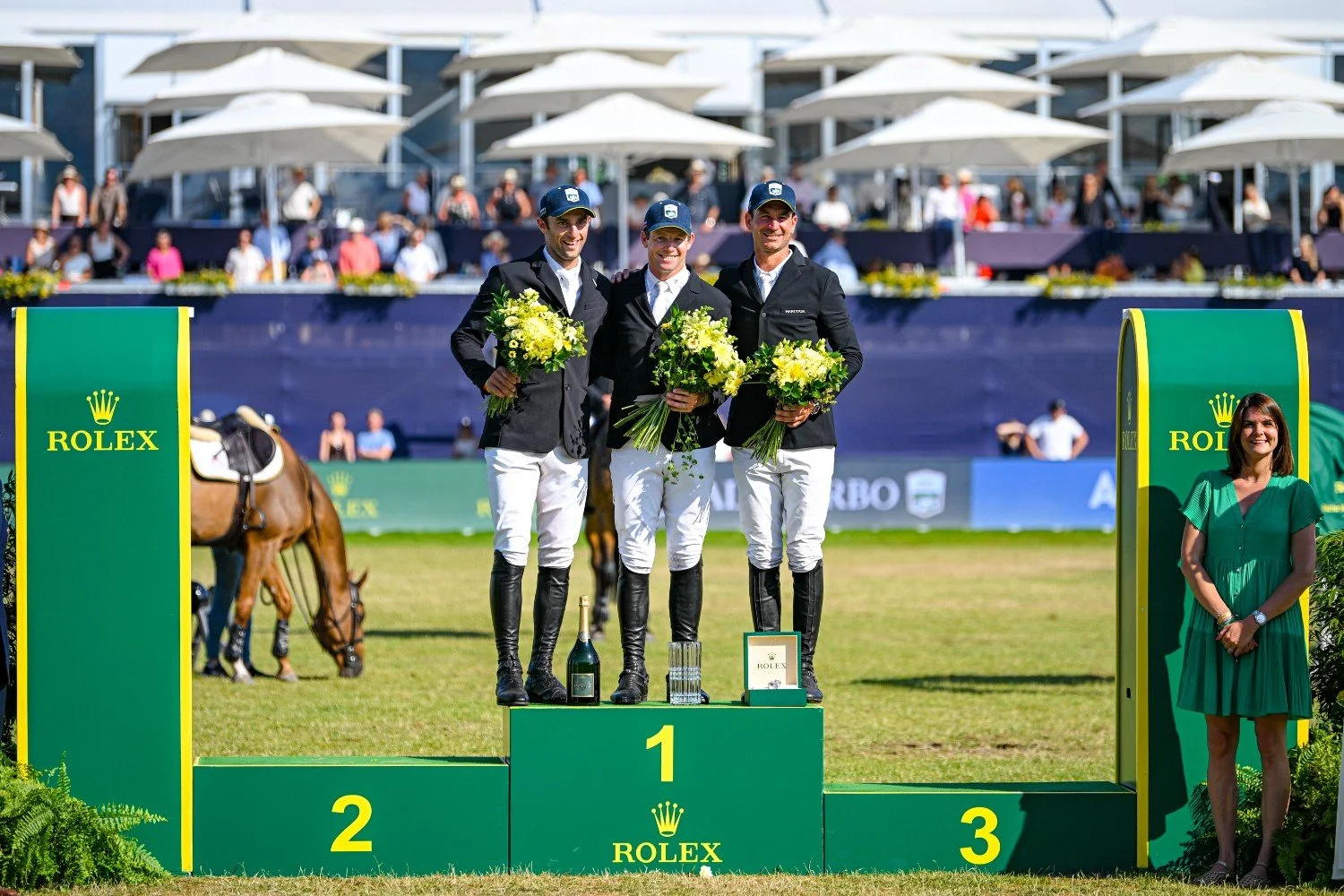
Winners of the Rolex Grand Prix presented by Agria 2026: Richard Vogel, Shan Sweetnam and Steve Guerdat at Falsterbo. Photo: ©M. Froment for Equerry Co.
The Rothenberger Factor
Here is the detail that made Falsterbo more than a normal July fixture this year: Rothenberger designed both these courses and the courses at the FEI World Championships in Aachen five weeks later.
That gave the entry list an unusual value. Falsterbo offered riders a grass-arena preparation under the same designer who would set the championship tracks, and the entry reflected it. Farrington headed the list as world number one, alongside Vogel at number two, Ben Maher at four, Sweetnam at seven and Guerdat at nine, plus Sweden's reigning world team champions Henrik von Eckermann, Peder Fredricson and Malin Baryard-Johnsson.
Read backwards from August, the Falsterbo results are a reasonable predictor. Guerdat, third here, won the individual world title. Vogel, second here, was on Germany's gold-medal team.
Switzerland's Friday, and a Dressage Postscript
Switzerland won the Agria Falsterbo Nations Cup on Friday 10 July, which set up Guerdat's week. The Falsterbo Derby followed on the Saturday.
Falsterbo also brought back five-star dressage this year, and the FEI Dressage Nations Cup finale on 11 July produced its own story: Denmark won on 229.653 from Sweden and Germany, with Cathrine Laudrup-Dufour and Mount St John Freestyle the individual winners on 83.718%. Germany still took the overall series title with 47 points, a fourth consecutive win, from Belgium and Sweden.
A show that can put a Rolex Series Grand Prix, a five-star Nations Cup, a Derby and a Dressage Nations Cup final into five days on the same site is doing something most organisers cannot, and it is the reason Falsterbo became the seventh Rolex Series event in 2025.