
More than ninety combinations from 31 nations came to Aachen across five grades, eleven sets of medals were decided over five days, and seven nations left with a Paralympic team quota for Los Angeles. By the end of it, one squad had rewritten the record book.
The United States won the team title with 236.135, the highest team score in the history of the FEI Para Dressage World Championship. Germany took silver on 229.875 and the Netherlands bronze on 227.639.
Marie Vonderheyden on Fan Tastico H, Fiona Howard with Diamond Dunes, Rebecca Hart riding Floratina and Kate Shoemaker aboard Vianne delivered it across four FEI Para Grand Prix B tests over two days in the Allianz Park Stadium. Chef d'équipe Michel Assouline's assessment was that the squad holds high expectations of itself, that those expectations do not always come to fruition, and that producing the highest team score ever recorded at a World Championship was incredible.
The Americans finished the week with six gold medals, tying Germany for the most golds of the entire Aachen programme across all six disciplines, and eight medals in total.
Shoemaker, Three Times
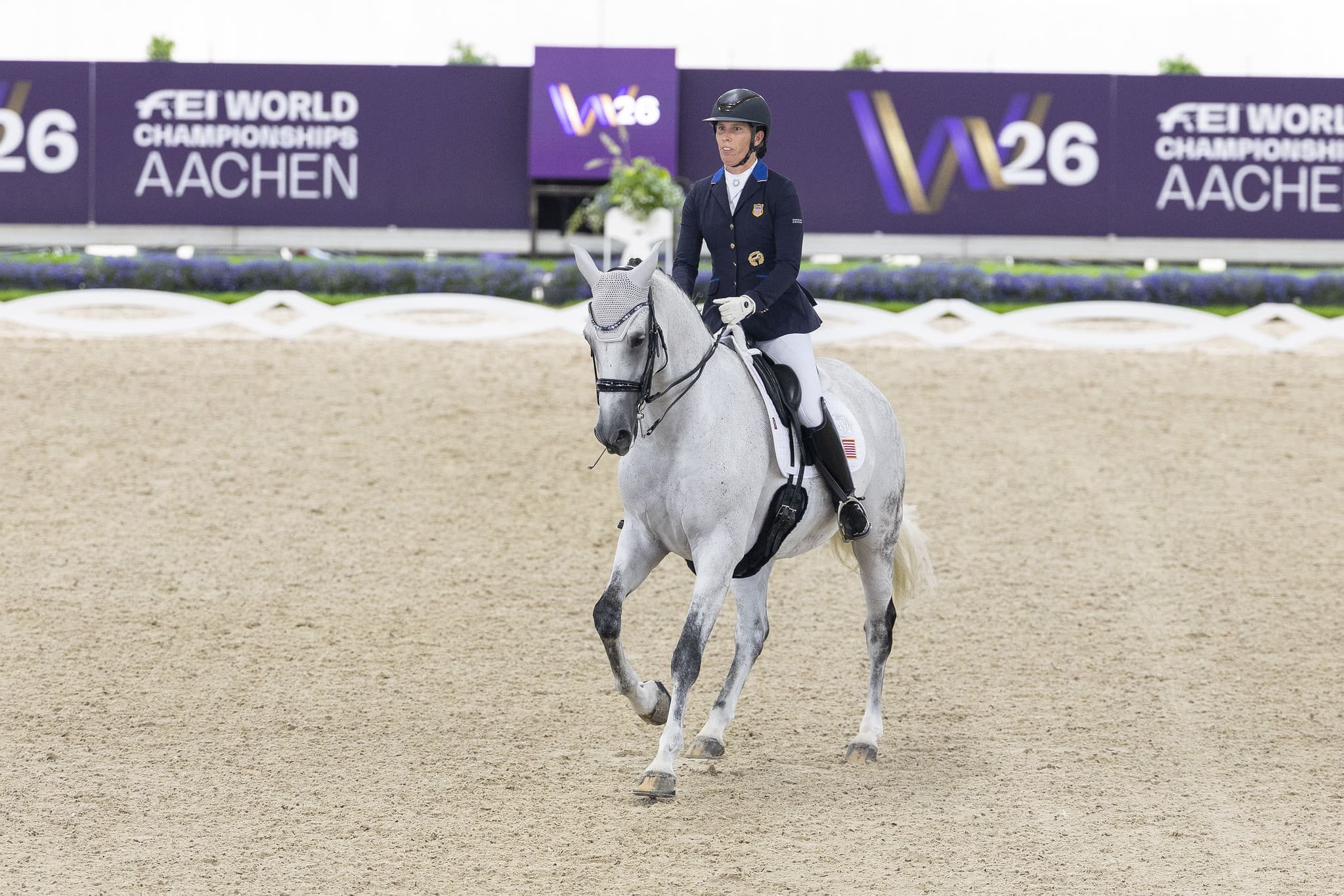
Kate Shoemaker (USA) riding Vianne winners of the Grade IV FEI Para Dressage World Championship. Image: © FEI/Leanjo de Koster
Kate Shoemaker and the grey mare Vianne won three gold medals.
They took the Grade IV individual title, then posted 80.460% in the team competition, the first score to break 80% at the championship and the highest individual total anyone produced across the whole team event. On the final day they won the Grade IV Freestyle on 83.305%.
Shoemaker's own summary was that coming away from Aachen with three gold medals was beyond what she could have hoped for.
She was not the only American to complete a hat-trick. Marie Vonderheyden won three golds on her championship debut, taking the Grade I individual title, contributing a personal best 76.375% to the team gold, and winning the Grade I Freestyle on a personal best 80.540% with Karin Flint's nine-year-old Oldenburg gelding Fan Tastico H.
Fiona Howard and Diamond Dunes, the Hanoverian gelding who carried her to gold in Paris, scored 79.300% in the team competition, the second-highest American score, and won the Grade II Freestyle on 81.866%.
The United States won team gold at the Paris Paralympics in 2024 and took team bronze at the 2022 World Championship in Herning. Aachen confirms a programme that has moved from the edge of the podium to the top of it inside four years, and did so this time by a record margin.
The Other Champions
The Netherlands' Rixt van der Horst won the Grade III individual title, ahead of Denmark's Tobias Thorning Joergensen and Italy's Francesca Salvadè, and added Freestyle gold on a personal best of 83.120%, the second of her two golds in Aachen.
Germany's Heidemarie Dresing had the week her home crowd wanted. She took the Grade II individual title with the eleven-year-old mare Poesie 143 in the mare's first World Championship start, added team silver, and collected a third medal of the championship with Freestyle bronze.
Sweden's Lena Malmström won the Grade V Freestyle and her first ever championship gold, describing it as a result that would bring real recognition to para dressage riders in Sweden.
France's Alexia Pittier, the reigning European Freestyle champion, took Freestyle silver on 78.645% with Sultan 768 on her World Championship debut.
Italy's Sara Morganti took Grade I Freestyle silver with Latvia's Rihards Snikus third, and Francesca Salvadè left Aachen with two individual medals and a Los Angeles qualification, describing it as a dream come true.
Britain's Week
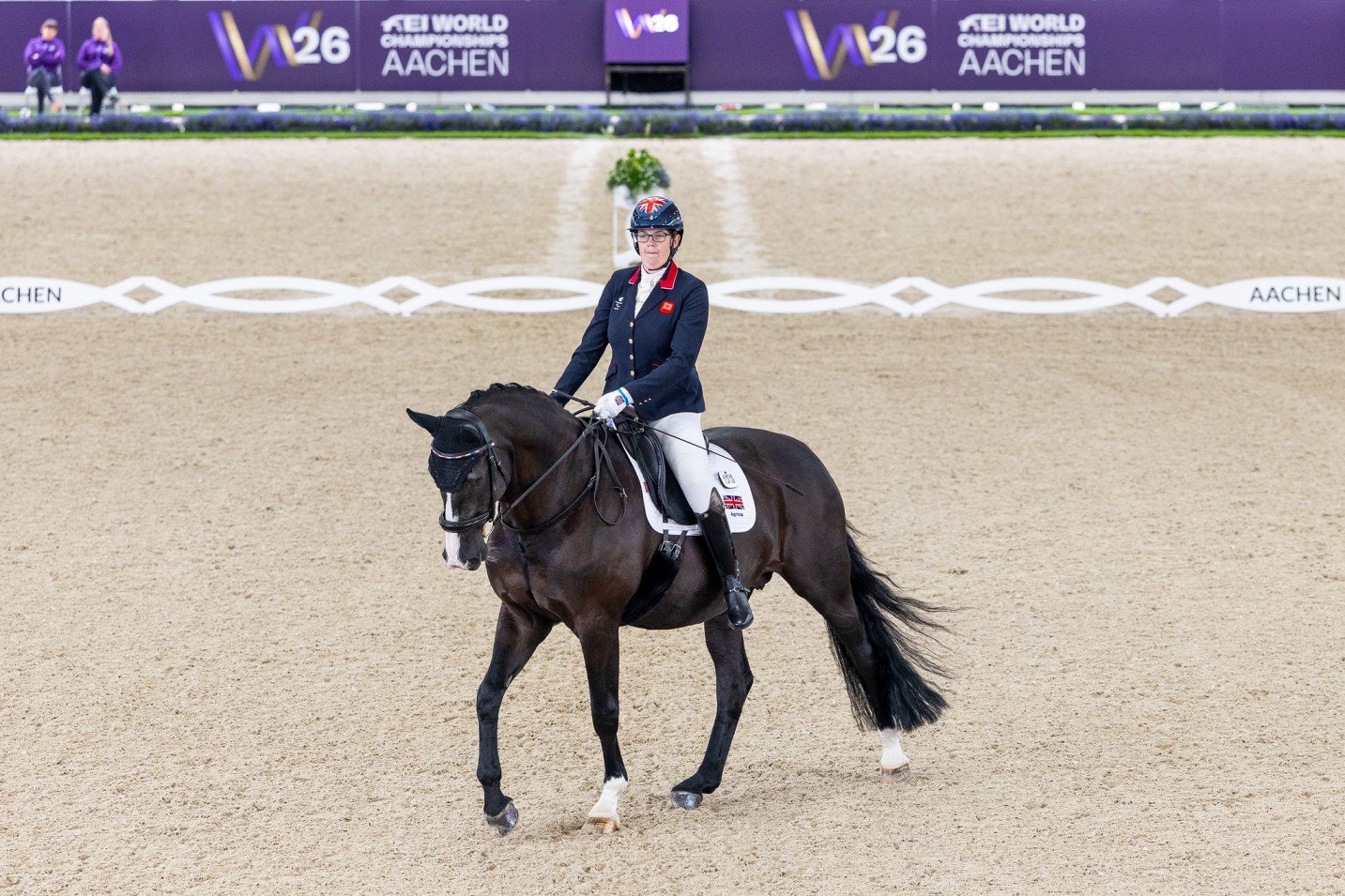
Mari Durward Akhurst (GBR) riding Athene Lindebjerg during the Team Final & Second Individual Qualifier for the Grand Prix Freestyle, Grade I of the FEI Para Dressage World Championship, Aachen 2026. Image: © FEI/Leanjo de Koster
Great Britain finished fifth in the team competition on 222.379, outside the medals but comfortably inside the top seven that secures a team quota place for the 2028 Paralympics.
Three individual medals came home, including two won by riders making their World Championship debuts with those horses.
Mari Durward-Akhurst and the 19-year-old Athene Lindebjerg took Grade I individual silver on 74.542%. Italy's Sara Morganti had set an early benchmark of 74.459% with Bond Girl 18; Durward-Akhurst went past it, and only Vonderheyden's 76.709% went past her. It was Durward-Akhurst's first World Championship medal, and her reaction was mostly about the mare, and about being pleased that Athene Lindebjerg is now a World Championship horse.
Jemima Green and Fantabulous took Grade II individual bronze on a career-best 75.241%, behind Dresing and Denmark's Katrine Kristensen, before returning on the final day to claim Grade II Freestyle silver on 80.933%.
Sophie Wells rode MSJ Gold Standard, and Nicola Naylor competed Humberto L with her caller Julie Riches, a late horse change that the British camp felt was vindicated by the result.
Fifth place and three individual medals is a respectable return, though not what Britain was long accustomed to. British para dressage won every Paralympic team title it contested between 1996 and 2021, and went unbeaten across every major championship until 2018. The competition has changed, decisively, and the nation that has displaced Britain at the top is coached by Michel Assouline, who served as British Para Dressage Head Coach from 2005 to 2017 and built much of the British programme before he left it.
What Else Aachen Decided
Seven nations secured team qualification for the Los Angeles 2028 Paralympic Games. Eleven sets of medals were awarded across the five grades, with the Individual Final Grand Prix A contested on 19 and 20 August, the Team Final Grand Prix B on 21 and 22 August, and the Freestyles across all five grades on 23 August.
Ninety-three horses went home afterwards, which is the detail the FEI chose to end its own report on, and it is a reasonable one. Para dressage sits closer to the welfare and social licence conversation than any other FEI discipline, because its horses are visibly the subject rather than the instrument of the exercise, and because the sport's public case rests on what those horses make possible.
The FEI Para Dressage Rules are undergoing a full revision, with the proposals going to the General Assembly vote in Jiangyin on 5 December. That gives this championship a second significance beyond the medals: it is the last to be contested under the current rulebook