Sunday in Bordeaux Crowns Martin Fuchs as Grand Prix Audi Champion
If Saturday night belonged to World Cup history, Sunday afternoon at Bordeaux delivered a crown of its own.
The Grand Prix Audi closed the Jumping International de Bordeaux with a distinct sense of occasion, reinforcing why this show continues to occupy a unique place on the indoor circuit. While Saturday’s Longines FEI Jumping World Cup™ class carried qualification pressure and historical weight, Sunday’s CSI5* Grand Prix stood apart as a standalone title, with its own honours board, its own rhythm, and its own measure of prestige.
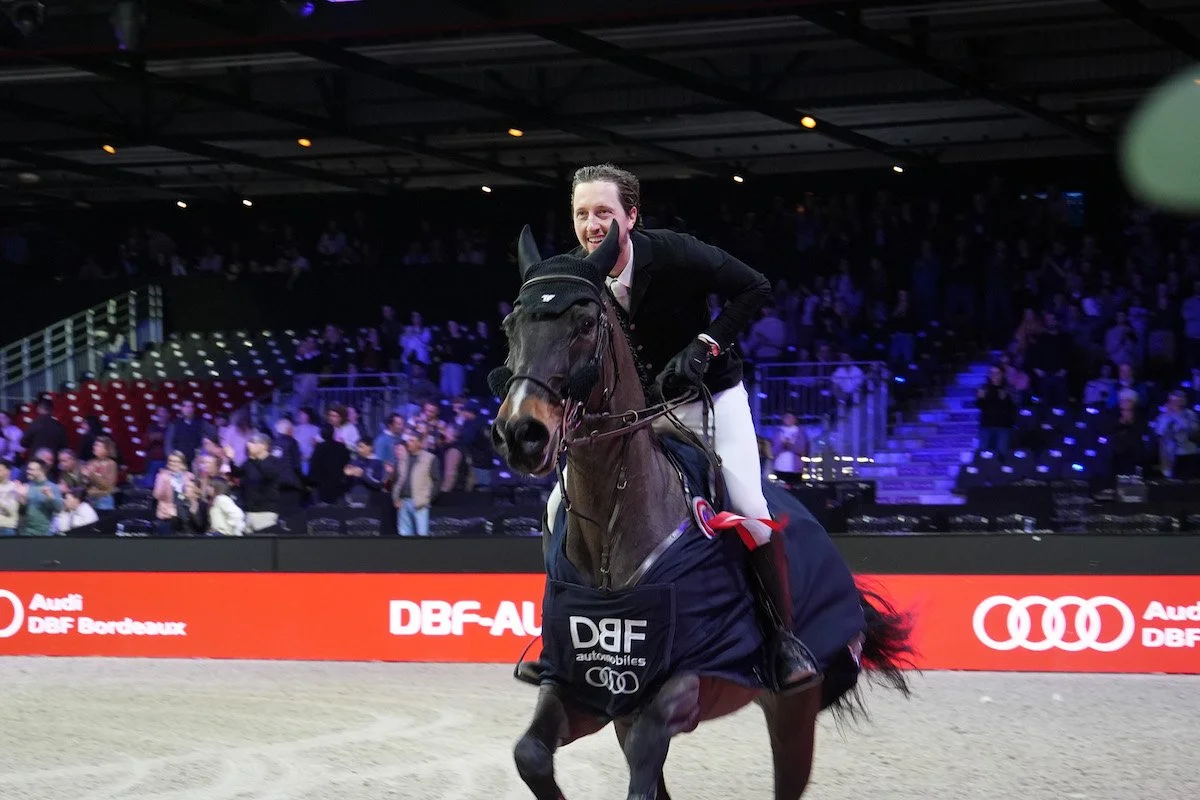
Martin Fuchs and Conner Jei takes the Grand Prix Audi after the disappointment in Saturday’s World Cup of Bordeaux. Image: ©Artiste Associe.
Grand Prix Audi
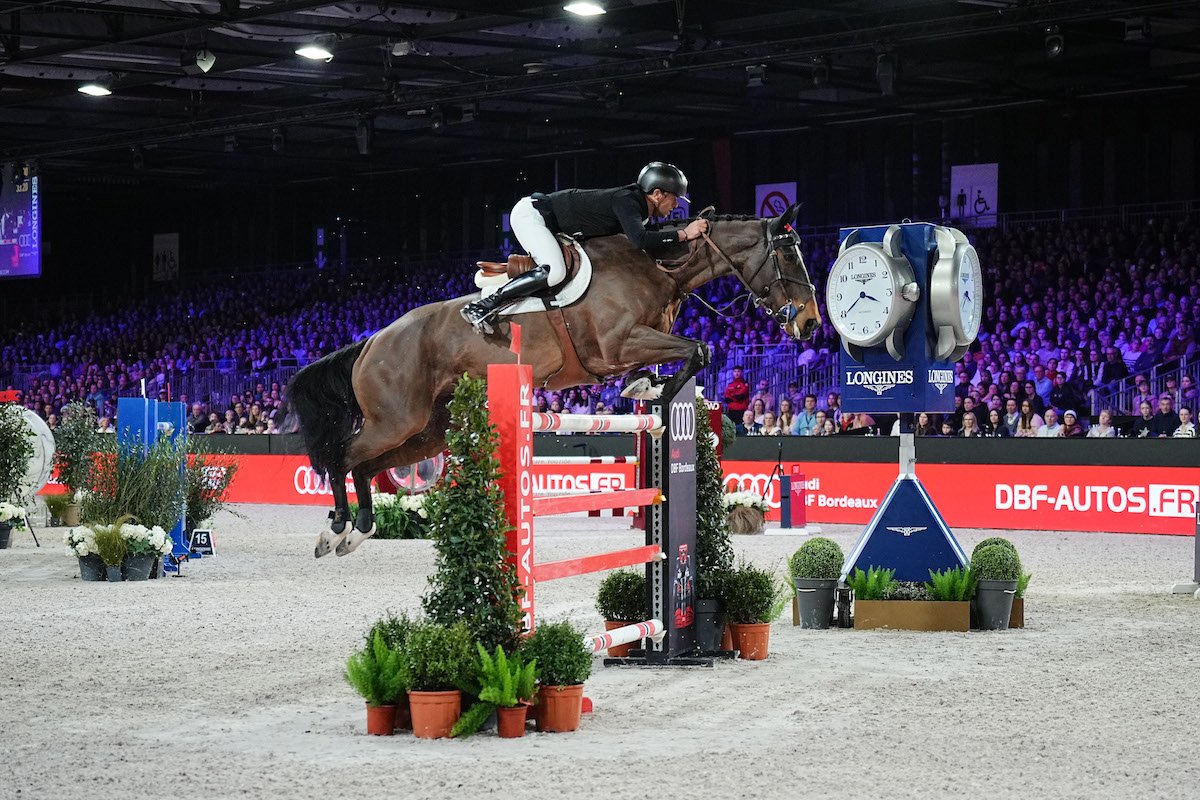
Victor Bettendorf. Image: ©Artiste Associe.
The Grand Prix Audi produced a jump-off that underlined both the depth of the field and the contrasting narratives between Saturday and Sunday. Seven combinations advanced to the jump-off, and notably, France was strongly represented, with three French riders making it through to the decisive round after having been absent from Saturday night’s World Cup podium and jump-off.
Victory went to Martin Fuchs (SUI) aboard Conner Jei, who stopped the clock in 34.32 seconds with a clear round to claim the Grand Prix Audi title. The win carried added weight after Saturday night’s disappointment, where four faults denied Fuchs the chance to make a successful comeback to his 2025 World Cup title in Bordeaux. Returning to the arena on Sunday, he and Conner Jei reclaimed the Grand Prix crown, underlining both the pair’s resilience and their effectiveness at this level.
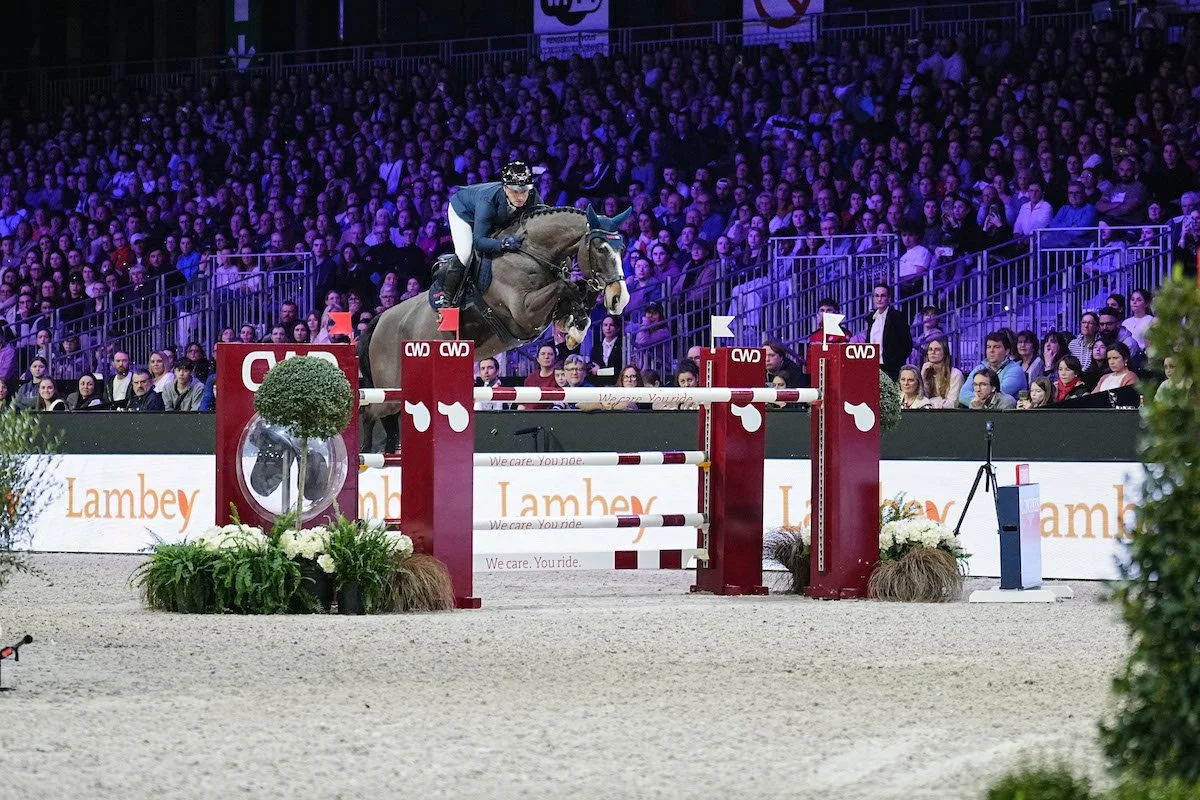
Five-Star eventer and showjumper Michael Jung took third place with Fischerheroes Z. Image: ©Artiste Associe.
Second place went to Victor Bettendorf (LUX) with Encore Toi du Linon, also clear in 34.47 seconds, while Michael Jung (GER) claimed third aboard Fischerheros Z in 35.30 seconds, adding another high-profile podium finish to a weekend defined by adaptability across disciplines.
Behind them, the French contingent featured prominently in the jump-off. Cédric Hurel, Camille Condé Ferreira and Marie Demond all carried hope of home victory, highlighting the contrast with Saturday’s World Cup class, where no French rider reached the jump-off. Sunday’s result also reshaped the weekend storylines for several riders. Fuchs’s rebound from Saturday to Sunday stood in contrast to others who found Bordeaux less forgiving across both days. Kevin Staut, Marc Dilasser and Roger-Yves Bost all finished Sunday on four faults after narrowly missing the jump-off, while Julien Epaillard, who had arrived with momentum after Friday night, collected eight faults in the first round of the Grand Prix.
A Second Crown, Not a Consolation
It would be easy to frame Sunday as an epilogue to Saturday’s drama, but Bordeaux has never positioned it that way. The Grand Prix Audi is explicitly billed as the second highlight of the jumping programme, and it rides like it.
Without World Cup points on the line, the pressure shifts. Riders are freer to commit, to take calculated risks, and to chase victory without the arithmetic of league qualification hanging over every decision. The result is often a different style of contest, one that rewards boldness and timing as much as precision. That dynamic was evident again this year, as the field reset after Saturday’s intensity and approached Sunday with fresh ambition.
Sunday’s Grand Prix also sharpened one of Bordeaux’s most enduring narratives: the idea that this arena consistently rewards riders who understand it. Over decades, a small group of athletes have demonstrated an almost uncanny ability to deliver here, returning year after year to add their names to the honours board in ways that go beyond form alone.
Organisers frequently point to Marcus Ehning as the clearest example. A three-time winner of the Grand Prix in Bordeaux since 1990, including two World Cup victories, his record represents a rare blend of longevity and venue mastery that few indoor arenas can produce. It is not simply about winning once, but about repeatedly peaking in the same demanding environment across different eras of the sport.
Seen through that lens, Sunday’s Grand Prix is not a secondary prize but a distinct crown, one that continues to reward riders capable of adapting, resetting and delivering when the weekend’s second decisive moment arrives.