
Leopold van Asten and VDL Groep Kwienbellie won Sunday's CSI4* Grand Prix at Jumping Indoor Maastricht, taking the home victory in a twelve-horse jump-off that came down to the final rider.
The Dutchman stopped the clock in 35.70 seconds, beating Belgium's Gilles Thomas with Riesling van't Roosakker on 36.26 and compatriot Willem Greve with Cero Blue TN on 36.82.
Forty-five combinations had started the 1.55m Grand Prix, presented by Gemeente Maastricht, with twelve qualifying for the jump-off and seven ultimately producing a second clear.
Van Asten was last to go, with a clear view of the time required.
The Last Rider Has the Advantage
Riding the eleven-year-old mare VDL Groep Kwienbellie, by Toulon out of an Indoctro mare, Van Asten took the risks necessary to win, particularly in the final line.
Eight strides to the last fence were enough to put him ahead of Thomas, the defending champion, and secure a Grand Prix victory that had previously eluded him at Maastricht.
It was also his second significant result of the weekend.
On Friday, the same combination had won the CSI4* 1.50m 3W Prix, completing the jump-off in 36.74 seconds. Maikel van der Vleuten finished second with Quastor vd Heffinck in 37.10, ahead of Michael Greeve and Rubens in 37.77.
Two victories across three days, culminating in Sunday's Grand Prix, made Van Asten and Kwienbellie the standout jumping partnership of the meeting.
For Maastricht, a Dutch winner on a mare bred in Limburg was an appropriate conclusion to the weekend.
Exell Extends His Maastricht Record
The other major international result came on Saturday evening, when Australia's Boyd Exell won the FEI Driving World Cup leg for the sixth consecutive time.
The eleven-time World Cup champion was the only driver to complete both rounds without penalties, producing a decisive drive-off in 142.62 seconds.
Belgium's Glenn Geerts finished second on 153.43 seconds, including eight penalty seconds, while the Netherlands' Koos de Ronde took third on 162.21.
Exell drove a four-in-hand team comprising Bajnok, Mad Max, Katydid Duchess and Barny, supported by navigator Emma Olsson and backstepper Wannes Larson.
The course, designed by Johan Jacobs, combined marathon-style obstacles with narrow passages and a bridge, demanding precision as well as speed. Each displaced ball added four penalty seconds, making clean execution particularly valuable.
Exell was not simply the quickest. He was the only competitor able to combine pace with a fault-free result throughout the competition.
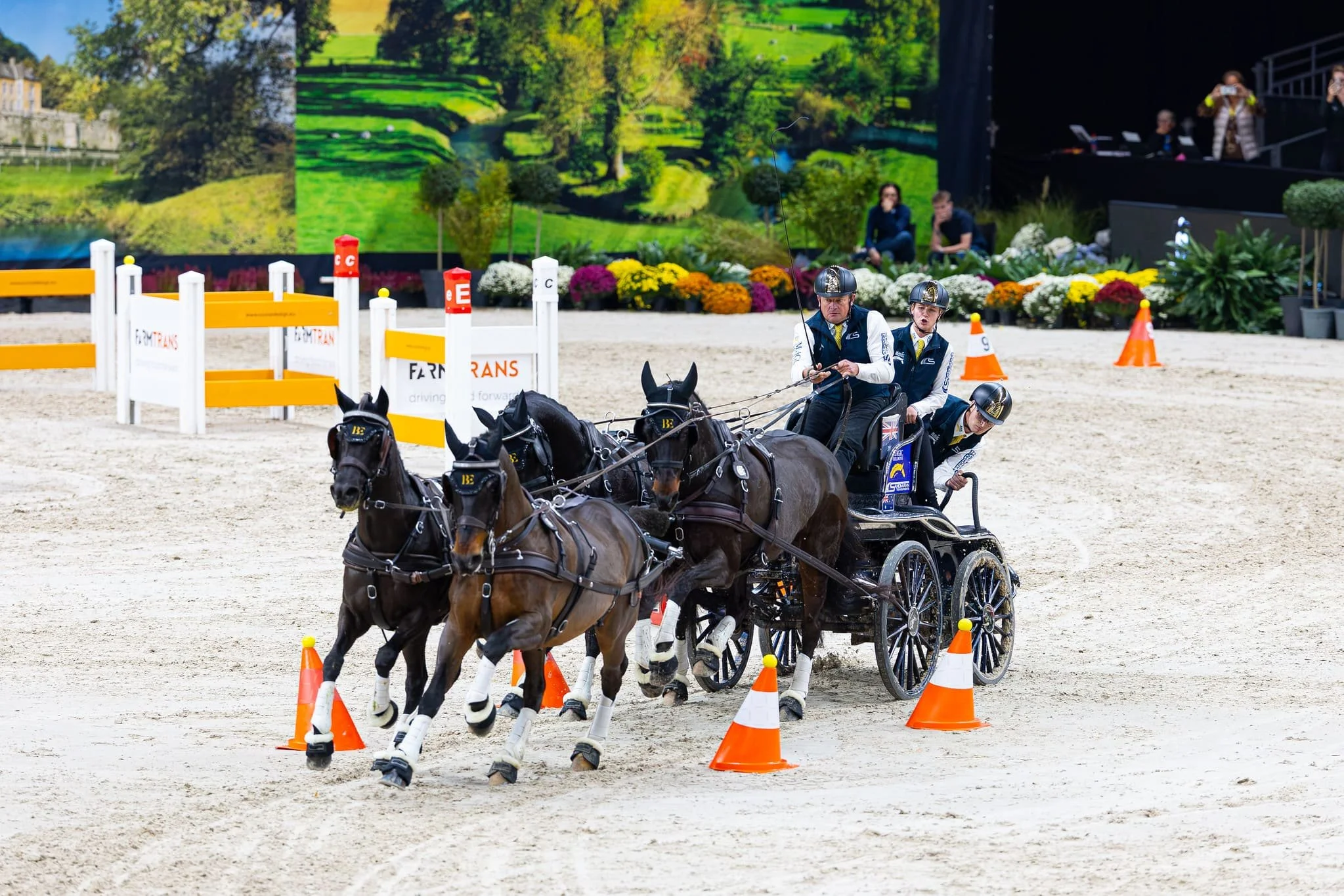
Boyd Exel (AUS) winner of the FEI Driving World Cup 2026 in Maastricht (NED). Image: ©FEI/Leanjo de Koster
The World Cup Points Tell a Different Story
Despite finishing second and third, Geerts and De Ronde collected no World Cup qualification points in Maastricht.
Both competed on wild cards, meaning their results counted towards the competition placings and prize money but not the series standings.
Fourth-placed Bram Chardon also competed on a wild card.
After the second leg of the 2026/27 FEI Driving World Cup season, Germany's Anna Sandmann led the standings on thirteen points, with Exell second on ten.
Sandmann had made history the previous weekend in Lyon by becoming the first woman to win a World Cup leg in four-in-hand driving.
Maastricht therefore produced two different sporting narratives: an established champion extending his record at a familiar venue and a relatively new World Cup winner retaining the early series lead.
Two Disciplines, One International Programme
Jumping Indoor Maastricht brought international jumping and four-in-hand driving into the same indoor arena, giving spectators two distinct forms of equestrian competition across the weekend.
The jumping Grand Prix rewarded speed, accuracy and the tactical advantage of a final draw. Driving demanded the management of four horses through a technical course, with every small error adding directly to the final time.
Both competitions were settled by combinations that delivered under pressure.
For Van Asten, it was a long-awaited home Grand Prix title. For Exell, it was another Maastricht victory in a record that now extends to six consecutive editions.
