
The New Riders of UK: Inside the Quiet Revolution of Chinese Equestrian Expats
For the global equestrian industry, the narrative surrounding China has long focused on hardware: the importation of expensive warmbloods, the construction of marble-floored stables, and the sheer volume of capital flowing from the East. However, more than a decade after the post-2008 Olympic boom, a quieter and more transformative trend is emerging. It is no longer just horses being shipped to China. It is a generation of people coming to Europe.
Fueled by the celebrity status of Olympian Alex Hua Tian and a rapidly expanding middle class, China’s equine industry reached a market value of 17.04 billion CNY (£1.81 billion) by 2021. Yet for the first generation of Chinese equestrians, money cannot buy the one thing they desire most: centuries of institutional knowledge.
To bridge this gap, a cohort of students, professionals, and aspiring athletes is embedding itself inside the UK’s historic equestrian institutions. We interviewed three of these individuals to understand the human bridge being built between the heart of the European horse world and the frontier of the Chinese market.
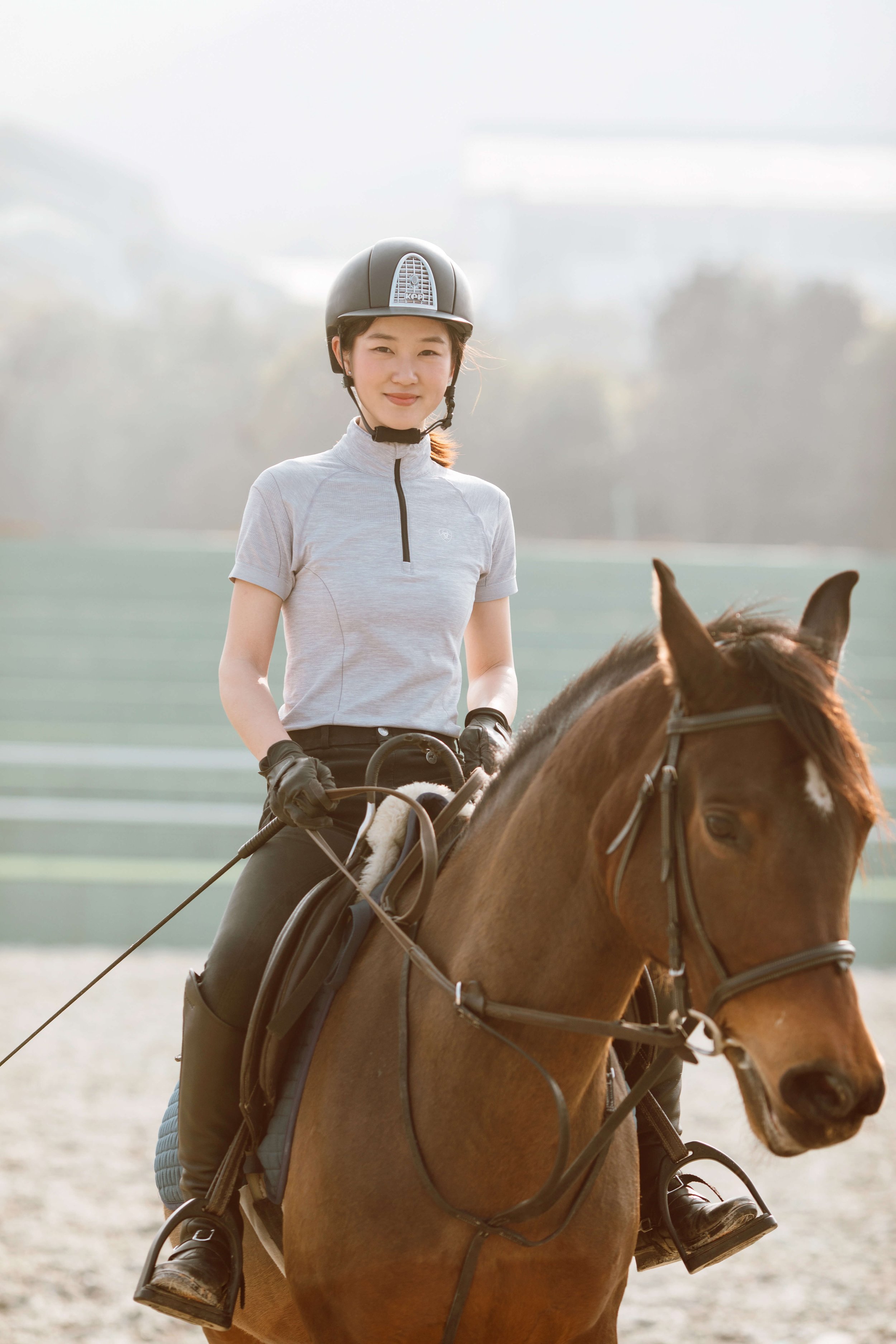
Image: Kate Feng
Building Bridges
Kate Feng, Hartpury Graduate and Proprietor
If the first step in this revolution was learning the sport, the second is importing the system. Kate Feng represents the shift from enthusiast to professional operator, bearing the responsibility of educating the next generation of Chinese riders about horsemanship.
Feng discovered riding at fourteen, introduced by her father. Finding no university-level equestrian degrees in China, she looked west and enrolled at Hartpury University in the UK to study Equine Business Management.
“The university courses gave me theoretical support, but the most important thing was my internship experience,” Feng recalls. During her time in the UK, she worked as a groom in both riding schools and competition yards, absorbing the operational rhythm of the British industry.
After returning to China to continue her family operation, the Chufeng Equestrian Club in Yixing City, Jiangsu Province, Feng encountered what she describes as a period of acclimatisation issues. She found herself attempting to graft British software onto Chinese hardware.
“In the UK, there is a shared common sense within the industry,” Feng explains. “In China, everyone’s understanding of horse operations is different.” While the UK market benefits from a mature and interconnected supply chain, from feed to farriery, China is still playing catch-up.
Despite these challenges, Feng has built a club with staying power. Founded in 2015, Chufeng now houses 30 horses and serves more than 400 members. Drawing on her Hartpury education, she has cultivated a warm, family-style environment with the ambition of creating a “100-year brand,” a concept rarely seen in China’s fast-moving market.
Feng believes the next leap for China’s equestrian industry will require more than facilities. It will require star power. “We lack influential figures,” she says, pointing to how freestyle skier Eileen Gu transformed winter sports in China. “If the equestrian world had someone like that, it would drive the entire industry forward.”
Standardising Education
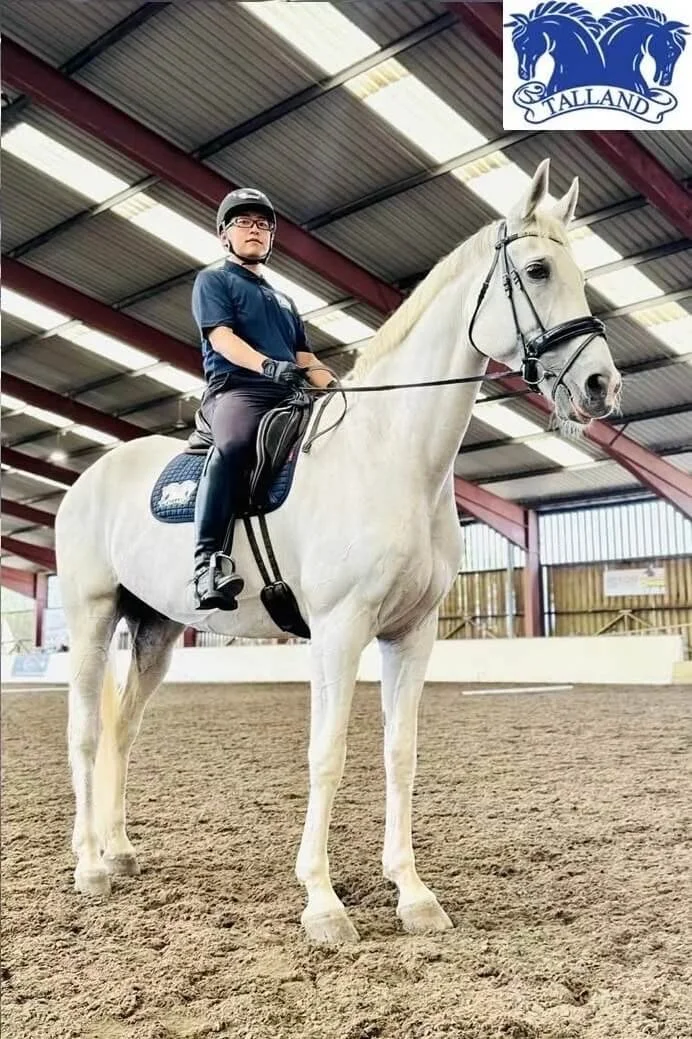
Image: Tiance Zhao at Talland School of Equitation.
Tiance Zhao, BHS Student at Talland School of Equitation
While Feng focuses on business architecture, Tiance Zhao is focused on educational foundations.
Zhao’s journey to a Gloucestershire stable yard began in an unlikely setting: a philosophy lecture hall in Glasgow. Originally from a Chinese province with a strong nomadic heritage, he moved to the UK to pursue a Master’s degree. As he worked on his dissertation, however, he felt increasingly disconnected.
“Extended periods of desk work made me feel removed from the real world,” Zhao explains. “I realised that no matter how much effort I put into philosophy, I might not find my place in academia.”
Seeking a more hands-on vocation, Zhao transitioned from university life to the Talland School of Equitation, one of the UK’s most prestigious British Horse Society training centres.
For riders arriving from China, where the equestrian boom has often outpaced regulation, the BHS system can feel rigid. For Zhao, the structure was liberating. “I believe theory and practice are mutually reinforcing,” he says. “Without anatomical knowledge, you rely passively on instruction. With knowledge, you gain the ability to think independently.”
Zhao has since achieved his BHS Stage 3 Coach in Complete Horsemanship and Stage 4 Dressage. These qualifications, however, have sharpened his awareness of the challenges facing the industry back home. In mainland China, he observes, yard management is often overlooked, and many riders from the older generation lack a foundational understanding of horse welfare.
This reality has shaped his future plans. Rather than returning to the mainland immediately, Zhao is looking toward the Hong Kong Jockey Club, an institution that holds British standards in high regard. His assessment of the mainland market is candid: “I do not believe riding clubs there are ready for the same standards as the UK. Many owners are investors, not horsemen.”
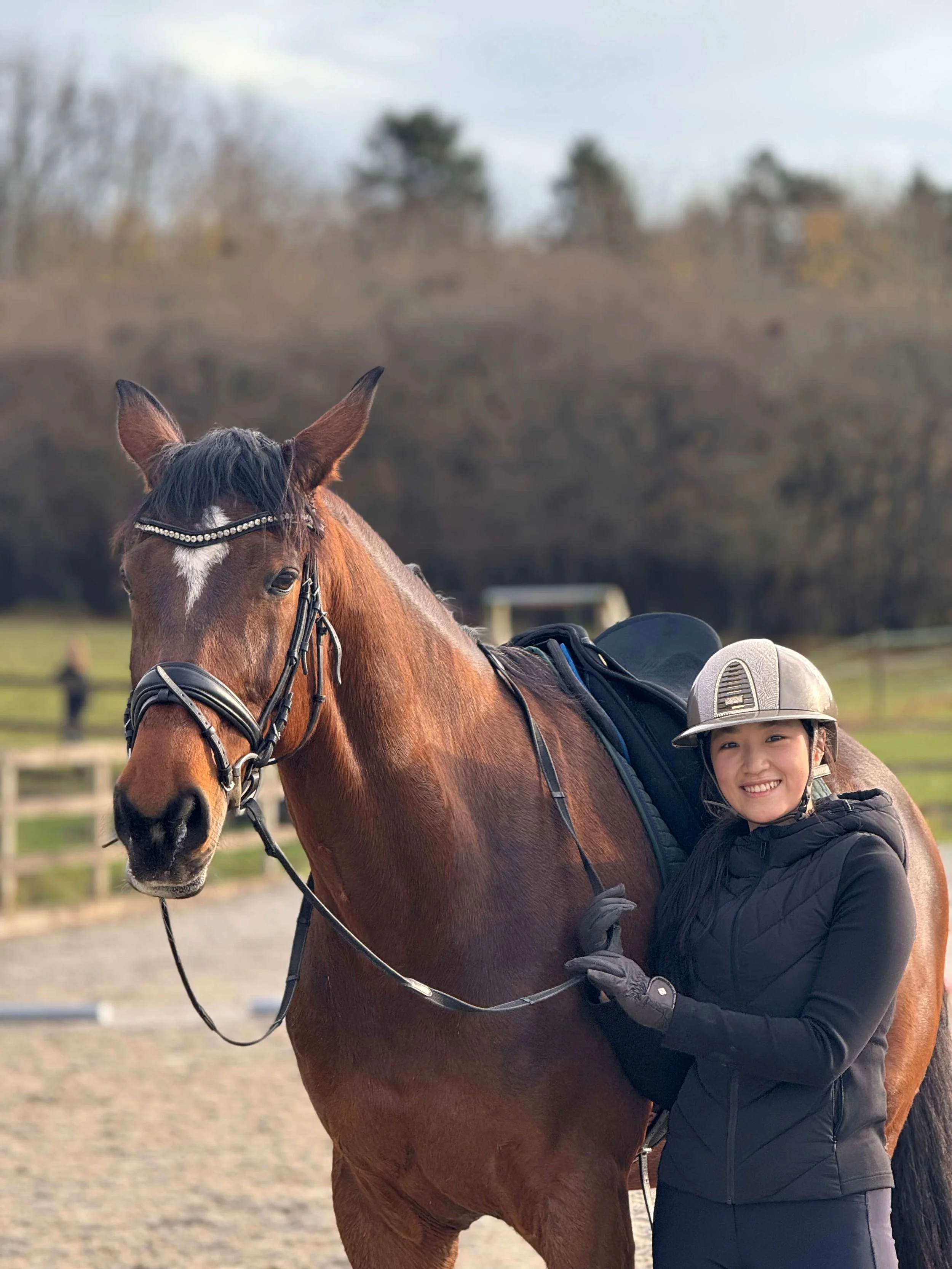
Image: Cindy Liu
Informed Horse Ownership & Self Growth
Cindy Liu, Young Rider and Horse Owner
While Feng and Zhao work within the industry, Cindy Liu represents the new face of the Chinese consumer: educated, affluent, and increasingly discerning.
Liu began riding seriously in 2022 and now divides her time between the UK and China. She identifies a fundamental cultural difference in how the sport is taught. “In the UK, riding is a lifestyle,” she says. “You see the horse as a teacher who cannot speak. In China, the student is treated as a customer. You arrive, the horse is already tacked up, and the focus is on efficiency and measurable improvement.”
Her desire for a deeper relationship with the sport led her to search for a schoolmaster, a horse capable of teaching her advanced dressage. Unlike many first-time owners drawn to young, expressive movers, Liu approached the process with notable restraint.
“I tried several four- and five-year-olds,” she admits. “Some had excellent bloodlines, but there was too much uncertainty. If I brought back a young horse, I would just be paying a trainer to ride it, and my own time would be wasted.”
Her search ultimately took her to Germany, where she purchased Julius, a 12-year-old, 17.1hh Rhinelander gelding competing at Inter I level. For Liu, Julius is not merely a competition horse, but a private professor.
Her ambition is to compete at Prix St Georges, yet her motivation remains deeply personal. “I believe my equestrian life in the UK will heal every moment of self-doubt in my life,” she says.
The Future
Together, these stories point to a critical evolution in China’s equestrian journey. Beyond importing horses and infrastructure, the new riders are investing in culture, education, and welfare.
Kate Feng is building a British-style club model in Jiangsu. Tiance Zhao is advocating for BHS standards in Chinese coaching. Cindy Liu is demonstrating a shift away from status-driven ownership toward informed horsemanship.
As the Chinese market matures, these cross-border ambassadors suggest that the future of the industry will be shaped not by the volume of trade, but by the depth of connection between people, horses, and traditions.