Teaching Equine Science Through Comics: Making Complex Ideas Accessible

Image: Mind of a Horse / Arador
Understanding the way horses think and learn has never been more important, both for welfare and for riders striving to improve their partnerships with their horses. Yet much of the research on equine behaviour, cognition and learning remains tucked away in academic journals, inaccessible to many in the broader equestrian world.
A new graphic book aims to change that by bringing equine science to life through engaging visual storytelling. The Mind of a Horse presents current scientific knowledge about how horses perceive their world, how they learn, and what contributes to their wellbeing, using illustration and narrative to make complex topics easier to grasp.
Created by a Finnish science communication team, the book follows a group of horses, including the “problem horse” Phoenix and a young colt named Spark, alongside their human companions. Through their everyday challenges and successes, readers are introduced to evidence-based concepts covering social behaviour, activity needs, sensory perception, motivation, emotions and consciousness, learning and training, problem behaviours, pain and illness, foal development, and relationships with humans.
Rather than treating these subjects in isolation, the story explores how they connect in real life. It examines which types of social contact matter most to horses, how stabling and turnout environments influence herd dynamics, and how dominance hierarchies can be managed to reduce aggression. It also looks at species-specific activity needs and explains why movement, choice and environmental enrichment play such an important role in brain health.
Readers are guided through the horse’s sensory world, highlighting how vision, hearing and touch differ from our own and how this shapes behaviour. Motivation and learning are explored in practical terms, addressing how horses process information, which training approaches support both performance and welfare, and what skills trainers need to encourage faster learning and more reliable outcomes.
The book also tackles common challenges such as resistance during saddling or bridling, bucking, phobias, stereotypic behaviours and aggression, helping readers understand root causes rather than simply symptoms. Health and pain are addressed through explanations of common conditions and the subtle signs horses use to communicate discomfort, alongside guidance on reducing risk through management. Early development receives similar attention, showing how a foal’s physical and social environment can influence brain development with long-term consequences into adulthood.
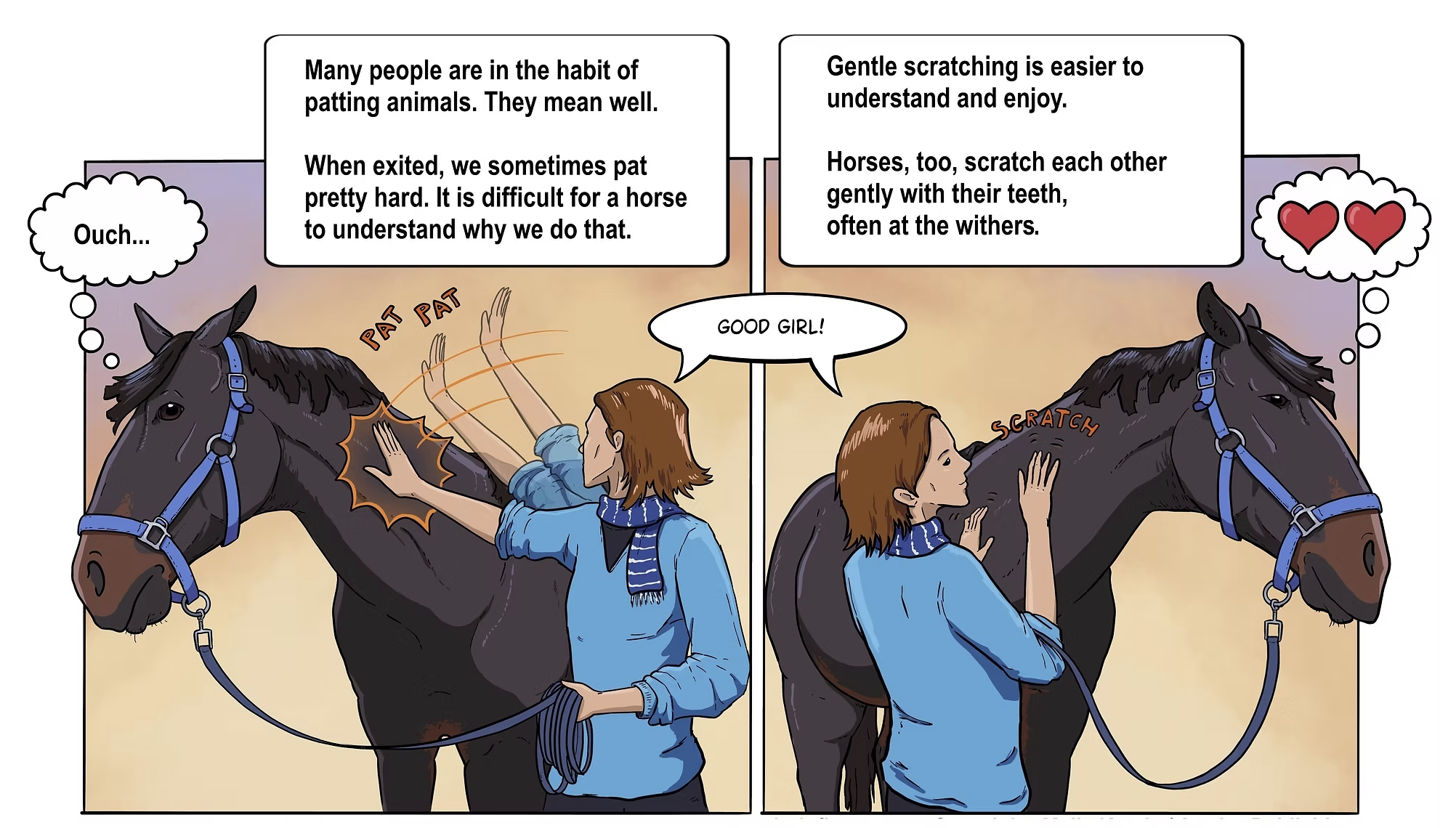
Image: Maija Karala / Arador Publishing.
At its core, the book emphasises the human-horse relationship, exploring how horses perceive us, how trust is built, and which less obvious aspects of daily life can affect handling and cooperation. The content is delivered in three complementary formats. The graphic novel storyline provides an accessible entry point for readers of all ages, roughly from ten to ninety-nine. Each of the ten chapters concludes with a written page offering deeper explanation, while QR codes throughout the book link to exclusive online material, including original scientific papers. This extended digital content has been praised as valuable even by experienced veterinarians.
The choice of a comic format is intentional. Educational research shows that visual storytelling can significantly improve engagement and knowledge retention. Studies on comics in learning environments demonstrate improved comprehension and more positive attitudes towards complex subjects compared with text-only approaches. Broader research into multimedia learning also shows that combining images with written content helps readers build stronger mental models, making abstract ideas easier to understand and remember.
For equestrians, this approach offers a practical way to engage with evidence-based horsemanship. By embedding scientific principles within relatable stories, the book encourages reflection on everyday interactions with horses and invites readers to apply learning theory and welfare insights to their own training and care routines.
Experts have welcomed the project for its clarity and originality. Andrew McLean, Co-Director of Equitation Science International, describes it as “a unique and friendly scientific approach”, adding that the characters are cleverly designed to illuminate the inner world of the horse.
Awards and Recognition
The impact of The Mind of a Horse has already been recognised internationally. In 2025, the book received multiple awards across both literary and educational categories, including Animal Book of the Year at the BREW Nonfiction Book Excellence Awards, Young Adult Nonfiction at the International Book Awards, and wins in Animals and Comics and Graphic Novels at the Firebird Literary Contest. It also received top honours in the Animals and Pets category at the Next Generation Indie Book Awards.
These accolades reflect growing recognition of alternative learning formats within both publishing and education, and underline the potential for visual storytelling to play a meaningful role in shaping how equestrians engage with science.
By translating complex research into accessible narratives, The Mind of a Horse offers a compelling example of how education, creativity and welfare can intersect. It also signals a broader cultural shift within equestrianism towards learning models that prioritise clarity, empathy and evidence, helping bridge the gap between academic insight and everyday horsemanship.
Sources:
Arador Innovations. Mind of a Horse. https://www.arador.fi/mindofhorse
Ozdemir, E. (2017). Using Comics in Science Education: A Meta-Analysis. Educational Psychology Review.
Mayer, R.E. (2009). Multimedia Learning. Cambridge University Press.
McCloud, S. (1993). Understanding Comics: The Invisible Art. HarperCollins.
Hosler, J. & Boomer, K.B. (2011). Are Comic Books an Effective Way to Engage Nonmajors in Learning and Appreciating Science? CBE Life Sciences Education.