Develop Suppleness: Gymnastic Jumping Exercises with International Showjumper Joe Fernyhough
We caught up with International Showjumper Joe Fernyhough for an insight into his training system and methods. As a coach and producer of quality showjumping horses, gymnastic jumping exercises are Joe’s go-to for all of the horses at his training facility in Gloucestershire UK - from those competing at 3* Grand Prix level, down to his homebred youngstock.
Joe believes in a clear and simple approach when training horses to give them the best chance of producing a correct answer, and building their confidence at every level. In showjumping you need to be able to do four things: whoa, go, left and right. “It sounds very simple, but you need to be able to do those things very well, and do it in balance with the pole or the fence in the right place,” Joe explains.
Below, Joe has shared one of his two favourite gymnastic jumping exercises with us. This can be tailored to any horse at any level, whether you’ve just started to introduce polework to your horse or they’re already competing at top level.
Exercise 1: Developing Suppleness
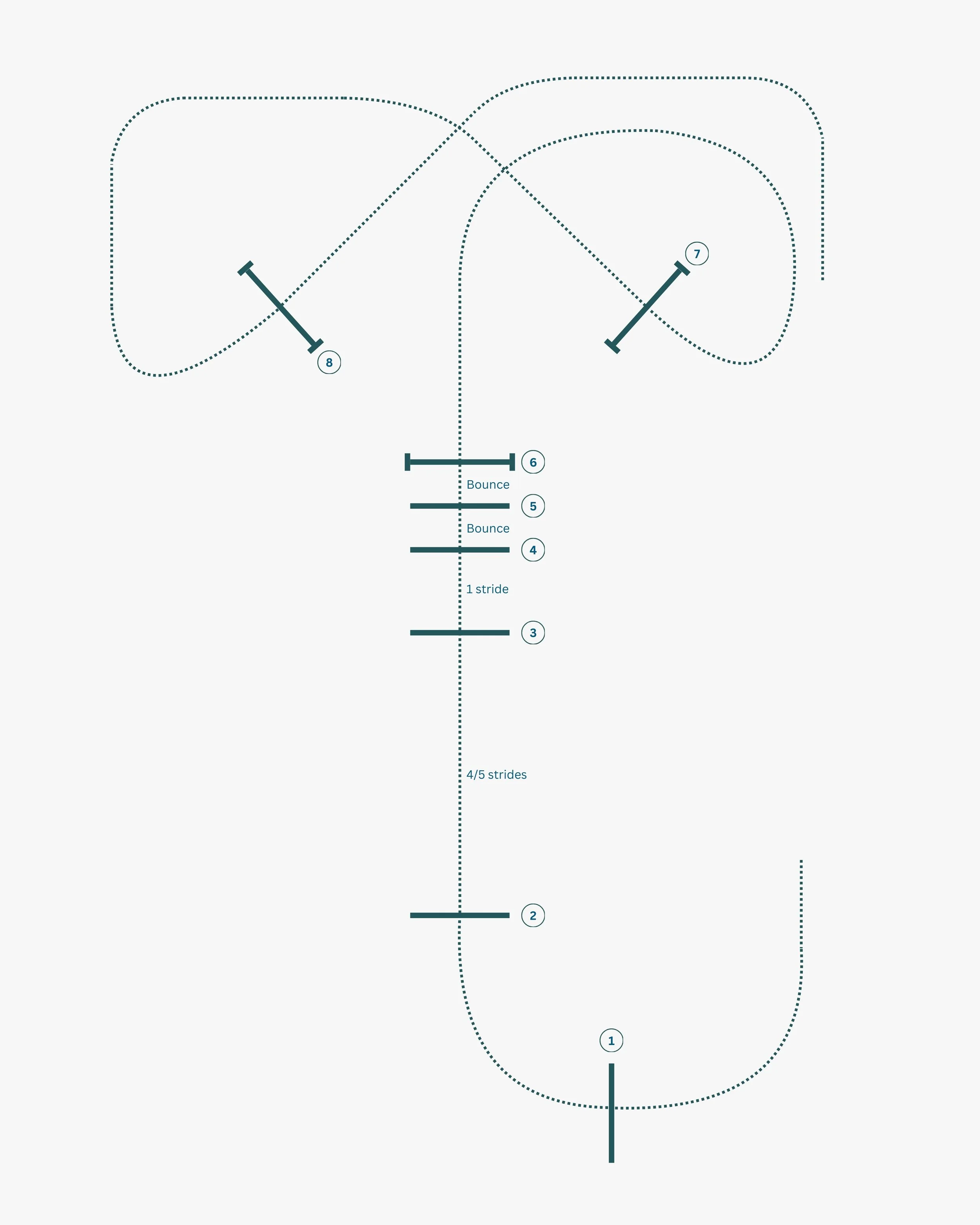
This simple gymnastic exercise is regularly set up in Joe’s arena at home. The exercise focuses on suppleness and bend in the horses’ body, whilst maintaining rhythm and balance through each corner to set up for the next fence.
Setting Up
For this exercise, you will need five ground poles, and three small jumps, raised poles, or cavalettis (depending on your preference). Use the diagram above to help you lay out the exercise, ensuring that there is a smooth curve with four or five strides between the first and second pole.
How to Ride It
Enter the first pole on the right rein, at a 90° angle from the long side, working in an engaged and connected canter with a little inside bend of the body to prepare for the turn. The turn should maintain balance and rhythm without losing straightness of the outside shoulder.
Upon landing, the horse should already be turning to the next pole, whilst remaining supple through the ribcage. On approach, the horse should now be completely straight between hand and leg and take off from the centre point of the pole.
The distance to the combination can be ridden on an open four strides, or a collected five strides. The distance should focus on maintaining rhythm of the stride, and straightness of the whole body.
The bounce combination is designed to encourage the horse to sit back on their hocks, engage their core, and lift through their shoulders to produce an elastic frame over the bounce fences. The rider must remain engaged in their own core, and offer softness in the hand to allow the horse to lift through the back and balance through the neck.
Upon landing, the horse should remain straight to the end of the arena, so not to cut the corner, before asking for inside bend of the ribcage to make the turns for the final two fences, again maintaining straightness of the outside shoulder to avoid drifting.
Over fence 7, ask for a lead change to the left by opening the new inside rein, and guiding the new lead with your shoulders and vision. Continue a figure-eight pattern towards fence 8 using the same principals.
Key Focus Areas
Suppleness: The continuous bending and rein changes encourage the horse to stay flexible through the turns.
Hind Engagement: The bounce elements require the horse to push from behind and strengthen the hindquarters.
Connection: You want the horse to stay focused, light on the aids, and maintain a steady contact.
Rhythm: The use of multiple ground poles and smooth turns help to maintain an even rhythm throughout the exercise.
EXTRA TIPYou can tailor this exercise to a younger horse by adding more poles, or or by varying the distances. For example, you could put them on one stride, one stride, one stride so that they have to stay in an even rhythm.
Bottom Line
As with all other schooling sessions, the aim of these exercises is to build confidence by starting small and slow, and gradually building them while they stay comfortable and positive about the experience. The great thing about gymnastic exercises is that the fences don’t need to be huge to have the desired outcome, and they allow you to fine-tune your horse’s jumping technique while you focus on your position and aids.
About Joe Fernyhough
Joe Fernyhough is based at Calcourt Equestrian, a family-run stud and showjumping facility, specialising in the breeding and production of quality horses, from all-rounders to Olympic prospects. The team is fronted by Joe’s parents, Rowland and Ali Fernyhough, and all three are qualified coaches and passionate about bringing out the best in any partnership. Some noteworthy results of Joe’s career so far include National U25 Champion in 2021 and jumping double clear on the Nations Cup team in Gorla Minore. He continues to successfully produce and compete his string of talented horses, ranging from those competing at 3* Grand Prix level, down to Calcourt’s carefully bred youngstock. For more information about Calcourt Equestrian, visit here.