Moody and Farrington Take Early Control on Opening Day of the Longines FEI World Cup™ Finals in Fort Worth
From the outset in Fort Worth, the structure of the Longines FEI World Cup™ Finals left little room for a conservative approach. There is little space to observe and adjust; instead, both dressage and jumping require riders to establish position immediately, knowing that early decisions would shape the remainder of the week.
Dressage: Moody Leads a Competitive Grand Prix
The opening Grand Prix of the Zen Elite FEI Dressage World Cup™ Final provided a clear measure of where the competition stands. With no variation in test or opportunity to play to individual strengths, the class placed full emphasis on execution, accuracy, and the ability to maintain structure throughout.
Becky Moody and her homebred Jagerbomb set the leading score of 76.761%, producing a test that combined power with elasticity without compromising control. The performance did not rely on isolated highlights; instead, it was built on maintaining quality across each phase of the test, particularly through the transitions where marks are often gained or lost.
Speaking afterwards, Moody reflected on both the atmosphere and the partnership that underpins the result. “The crowd in there were just incredible,” she said, noting that the energy inside Dickies Arena required focus from the outset. Of Jagerbomb, she added, “He is my baby. I bred him, so we’ve done everything together. He’s taken me on this incredible journey.”
Christian Simonson produced one of the defining performances of the day to finish second on 75.413% with Indian Rock. Competing in his first World Cup™ Final, the 23-year-old American combination moved into the lead during the latter half of the class, driven by strength in the piaffe work and a test that maintained clarity under pressure.
His reaction reflected both the moment and the scale of the occasion. “It’s surreal,” he said. “I’m so proud of my team and of my horse. I’m so lucky to ride Indian Rock. He’s just such a special horse.” Riding on home soil added another layer, with Simonson noting the significance of the setting and the support from the crowd.
Patrik Kittel and Touchdown completed the top three on 72.869%, delivering a performance that kept them firmly in contention heading into the freestyle. For Kittel, now competing in his eleventh World Cup™ Final, the focus remains on building across the phases of the competition. “I’m feeling great,” he said. “I think I can put a little more on top of that for the Freestyle, which is my speciality”.

Becky Moody (GBR) and home-bred Jagerbomb (Dante Weltino x Jazz). Image: © FEI/Shannon Brinkman
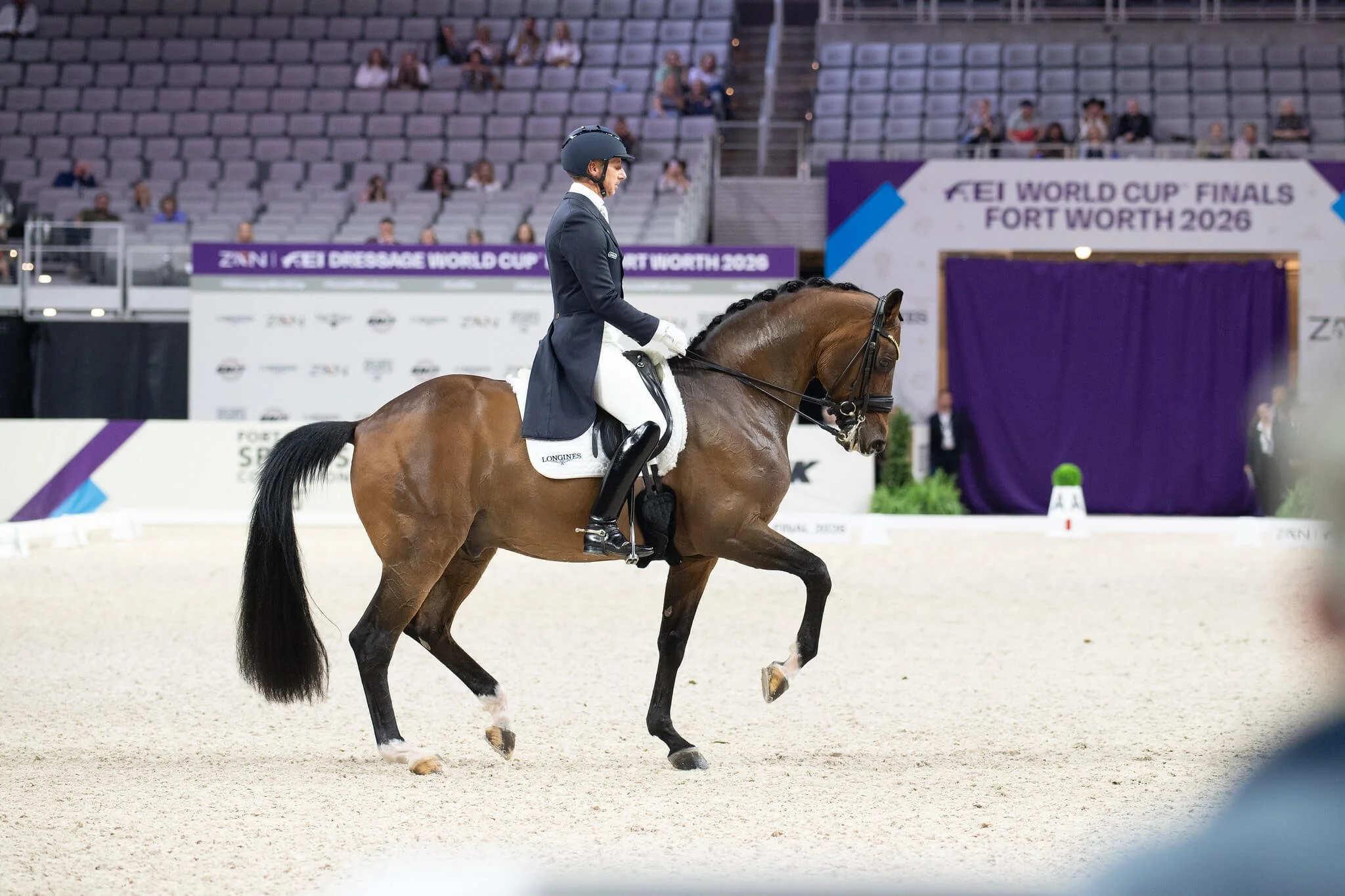
Patrik Kittel (SWE) and Touchdown (Quaterback/Björsells Sack 907), the most winning Swedish bred horse of 2023. © FEI/Shannon Brinkman

Christian Simonson (USA) and stallion Indian Rock (Apache x Vivaldi), previously ridden by Dutch rider Emmelie Scholtens. © FEI/Shannon Brinkman
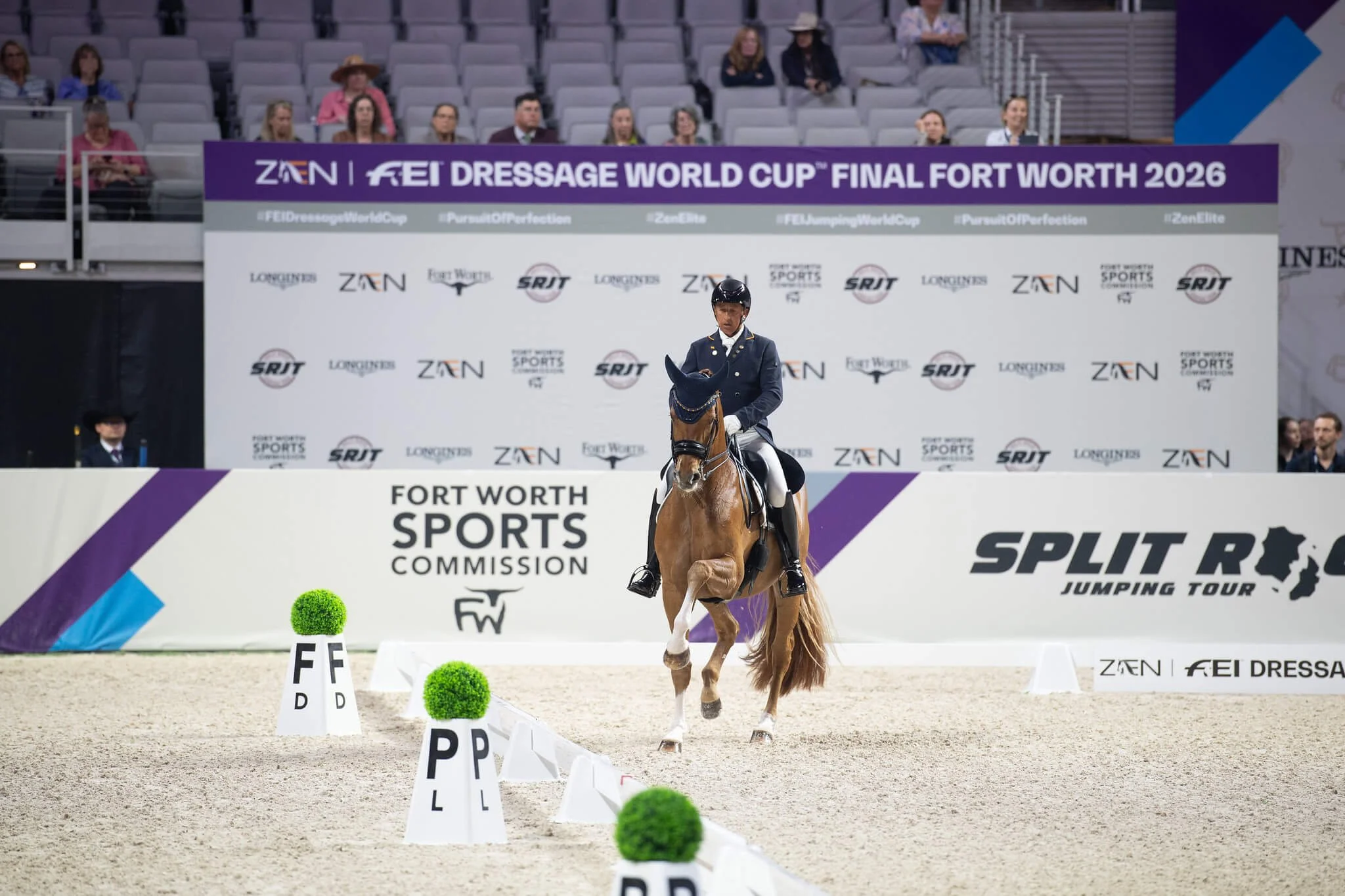
Julio Mendoza Loor (ECU) with Jewel’s Goldstrike (Bretton Woods x Scandic), a horse he alledgidly bought for $20 due to his difficult nature, and was retrained using natural horsemanship. © FEI/Shannon Brinkman
Earlier in the class, Julio Mendoza Loor set the initial benchmark with Jewel’s Goldstrike, scoring 72.000% and holding the lead through the first half of the competition. His reaction captured the significance of the moment. “I know my horse. I believe in him,” he said. “He’s taken me places I could never go.”
The broader pattern across the class reflected the demands of the Grand Prix format. Without the flexibility of freestyle choreography, the test exposed any inconsistency, particularly in elements such as the halt and rein back, which proved influential in the final order. Combinations that maintained clarity and connection throughout were rewarded, while small losses accumulated quickly.
The top eight was completed by Julio Mendoza Loor in fourth, followed by Sandra Sysojeva, Moritz Treffinger, Alexa Fairchild, and Morgan Barbançon, with margins remaining close behind the leading group.
With no scores carrying forward into the freestyle, the standings provide position rather than security. Moody holds the advantage, but the title will be decided in a format that allows the order to be reshaped.
Jumping: Farrington Leads a Tightly Packed Speed Phase
The opening jumping class, run under a Table C speed format, immediately introduced consequence into the standings. With no jump-off and three seconds added for each rail, the class required riders to balance pace with precision, knowing that penalties would carry forward into the remainder of the final.
Kent Farrington and Toulayna set the benchmark with a clear round in 62.03 seconds, establishing an early lead in a class where margins were measured in hundredths. His approach reflected a commitment to the plan established during the course walk, removing distance where possible while maintaining a consistent rhythm throughout.
“I thought she was great,” Farrington said of the 12-year-old mare. “She’s really versatile. She can jump any venue, and to step into this arena and go fast on the first day, she’s so reliable. It’s a great start to the Final.”
The nature of the course, designed by Anderson Lima, ensured that decisions carried immediate consequences. Riders who encountered an early rail were forced to adjust mid-round, either increasing risk to recover time or consolidating to avoid further penalties. The final fence proved particularly influential, with several combinations, including Kevin Staut and Richard Vogel, seeing rails fall while pushing for competitive times.
Daniel Deusser moved into second place with Otello de Guldenboom in 62.21 seconds, delivering a round that combined accuracy with efficiency. “Otello felt very good today,” he said. “He made it very easy for me. I had to focus on leaving a few strides out, but he kept a very good overview.”
Steve Guerdat, chasing a fourth World Cup™ title, sits third with Albfuehren’s Iashin Sitte on 62.49 seconds. For Guerdat, the priority was navigating a phase that often proves costly. “Table C is a class that you like to have behind you,” he said. “There’s a lot to lose. The result is very good. I was hoping for top five, so I’m very happy with third place.”
Behind the leading trio, the standings remain tightly grouped. Lillie Keenan holds fourth despite carrying a time penalty, followed by Jacob Pope and Aaron Vale, whose early clear round set the initial pace. Abdel Saïd, Yuri Mansur, Kevin Staut, and Jessica Burke complete the top ten, with minimal separation across the group.
The class also reflected a broader dynamic within the field, where a mix of championship experience and first-time finalists produced contrasting approaches. Some combinations prioritised a clear round and accepted a slower time, while others chose to apply pressure early, aware that the penalties incurred here will remain part of the overall result.
Looking ahead, Farrington confirmed a change of ride for the next phase, with Greya set to compete on Friday. “We have a good start, but we have a long way to go,” he said. “There are some of the best riders in the world behind me, so it will be a battle until the end.”

Kent Farrington (USA) and Toulayna (Toulon x Parco). © FEI/Shannon Brinkman

Daniel Deusser (GER) and Otello de Guldenboom (Tobago Z x Caretino). © FEI/Shannon Brinkman

Steve Guerdat (SUI) with Albfuehren’s Iashin Sitte (Bamako de Muze x Tinkas Boy). © FEI/Shannon Brinkman
From Opening Phase to Final Outcome
The first day in Fort Worth has not determined the outcome of the Longines FEI World Cup™ Finals, but it has defined the conditions under which the rest of the competition will unfold.
The structure of the schedule ensures that momentum now becomes cumulative. In jumping, the second phase on Friday evening shifts to a Table A format with a jump-off, where faults begin to carry greater weight than time alone. Riders who chose to build an early advantage on day one will need to consolidate it, while those further down the order must decide how much risk is required to recover ground without compounding penalties.
The final day on Sunday then brings two rounds over a full championship track, where the leaderboard is no longer shaped by individual performances, but by the ability to sustain consistency across multiple efforts. By that stage, the margins established in the opening speed class are no longer theoretical; they define what is possible.
In dressage, the progression follows a different structure but places equal emphasis on timing. With no scores carrying forward, Saturday evening’s freestyle becomes a reset in numerical terms, but not in context. The Grand Prix has already established the level of precision required, and the combinations that produced clarity on the first day enter the final phase with a clear reference point for what must be maintained and what can be added.