Pressure Builds Ahead of Saturday Night as Julien Epaillard Sets the Pace in Bordeaux
On paper, Saturday night in Bordeaux is simply another Longines FEI Jumping World Cup™ qualifier. In reality, it is the emotional and competitive fulcrum of the entire weekend.
Hosted by the Jumping International de Bordeaux, Bordeaux does something few World Cup venues attempt, let alone execute consistently. It places its Jumping World Cup qualifier squarely in Saturday evening prime time, then follows it with the opening competition of the Driving World Cup Final later the same night. Two elite disciplines, back to back, under lights, in front of a crowd that has already committed to staying late. That scheduling alone makes Bordeaux structurally different from a standard indoor “leg”.
Most World Cup qualifiers are built around Friday night features or Saturday afternoon sport, with ancillary classes filling the gaps. Bordeaux flips that model - Saturday is not a warm-up for Sunday. Saturday is the main event, and everything else orbits around it.
From an editorial perspective, that creates a rare scene-setting opportunity. The arena atmosphere builds through the afternoon, peaks during the Jumping World Cup, and carries straight into championship Driving. It lends itself to live blogs that feel cinematic, to colour writing that moves from Jumping intensity to late-night endurance, and to weekend columns framed not around isolated results but around a continuous evening of elite indoor sport.
It also changes rider behaviour. A Saturday night qualifier in Bordeaux does not feel like a routine points class. It feels like a headline moment. Riders arrive knowing they are stepping into the loudest arena of the weekend, at the most watched time slot, in a venue with deep World Cup history. The pressure is different, and so are the decisions. Horse choice, jump-off risk and tactical conservatism are all filtered through the knowledge that this is Bordeaux, not just another stop on the FEI Jumping World Cup calendar.
Experience Meets Opportunity Ahead of the Longines FEI Jumping World Cup™
One of the quieter storylines emerging from Thursday and Friday’s start lists is the balance between Bordeaux regulars and riders still looking to make a real mark in this arena.
At one end of the field sit familiar names who have returned to Bordeaux across multiple seasons and know exactly what Saturday night demands. Riders such as Kevin Staut, Martin Fuchs, Julien Epaillard, Roger Yves Bost, Denis Lynch and Max Kühner arrive as proven World Cup campaigners, riders for whom Bordeaux is not an unknown quantity but a familiar pressure point on the indoor circuit.
These are athletes accustomed to managing qualification mathematics, arena atmosphere and jump-off risk in equal measure. Their presence immediately gives Saturday night shape, bringing experience, expectation and established routines into play. Several arrive with more than one horse, signalling strategic depth rather than single-shot ambition, and reinforcing the sense that Bordeaux is being treated as a deliberate campaign stop rather than a standalone outing.
Alongside them is a broader group of riders who appear less frequently at Bordeaux at CSI5*-W level, or who are still building their indoor World Cup profiles. For these combinations, Friday’s Prix FFE Generali offers something different: not just a rehearsal for Saturday, but an opportunity to announce intent. These are the pairings watching how the arena rides, gauging crowd energy, and deciding whether this weekend is about consolidation or calculated risk.
Editorially, that mix matters. Bordeaux often becomes a meeting point between established World Cup narratives and emerging momentum, where seasoned campaigners defend territory while newer contenders look for breakthrough performances. It creates a natural tension between familiarity and opportunity, between riders managing expectations and those arriving with little to lose.
What cannot be safely assumed from start lists alone is who has previously placed here, who has come close without converting, or who is stepping into Bordeaux for the first time. But what is clear is that this field blends riders returning to a venue they know well with athletes still searching for their defining Bordeaux moment. That alone provides fertile ground for storytelling, especially once Friday begins to reveal which combinations are finding rhythm and which are keeping their powder dry.
As the weekend progresses, those contrasting trajectories tend to sharpen. Experience often shows in efficiency and composure, while opportunity reveals itself through bold lines and ambitious jump-offs. Bordeaux has a way of exposing both, and Saturday night rarely belongs exclusively to one group or the other.
By the time the World Cup qualifier arrives, the narrative is no longer just about points or placings. It becomes about who knows how to win here, who believes this could be their moment, and how those competing instincts collide under lights.
Friday Sets the Tone
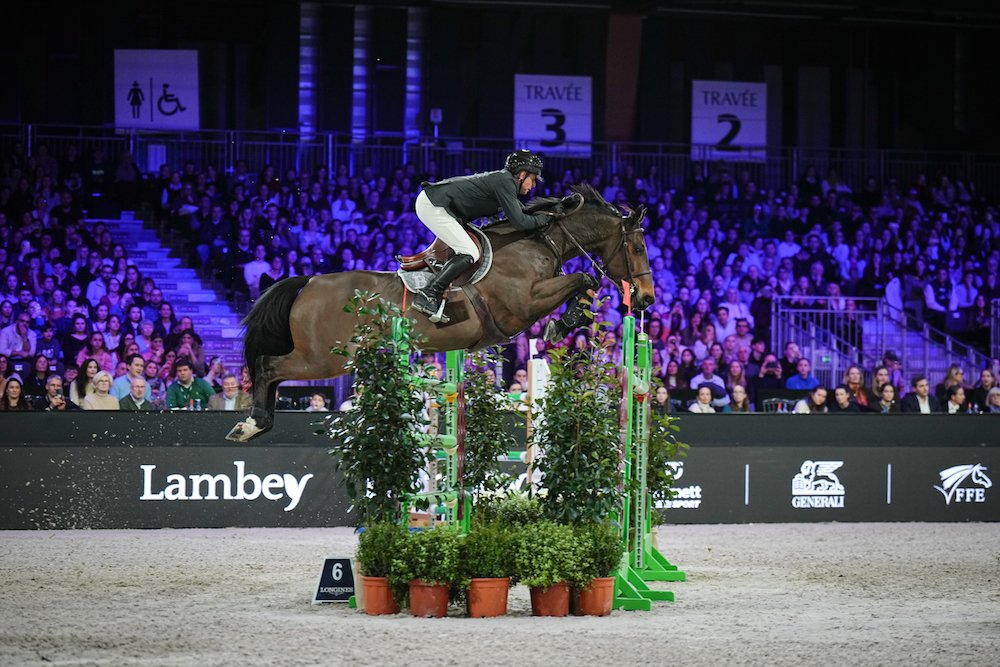
Julien Epaillard (FRA) and Donatello d’Auge.
Before Saturday takes centre stage, Friday night delivered Bordeaux’s first meaningful competitive read. The Prix FFE Generali acted as both ranking class and rehearsal, giving riders their first opportunity to test the arena at pace and height under lights. For some, it served as a confidence-builder; for others, a deliberate schooling round ahead of the World Cup qualifier.
At the top of the leaderboard, Julien Epaillard (FRA) set the early benchmark aboard Donatello d’Auge, stopping the clock in 57.00 seconds to take the win. He was followed closely by Daniel Deusser (GER) with the 15-year-old stallion Bingo Ste Hermelle in 57.46, while Marc Dilasser (FRA) claimed third place on Arioto du Gevres with a time of 59.15.
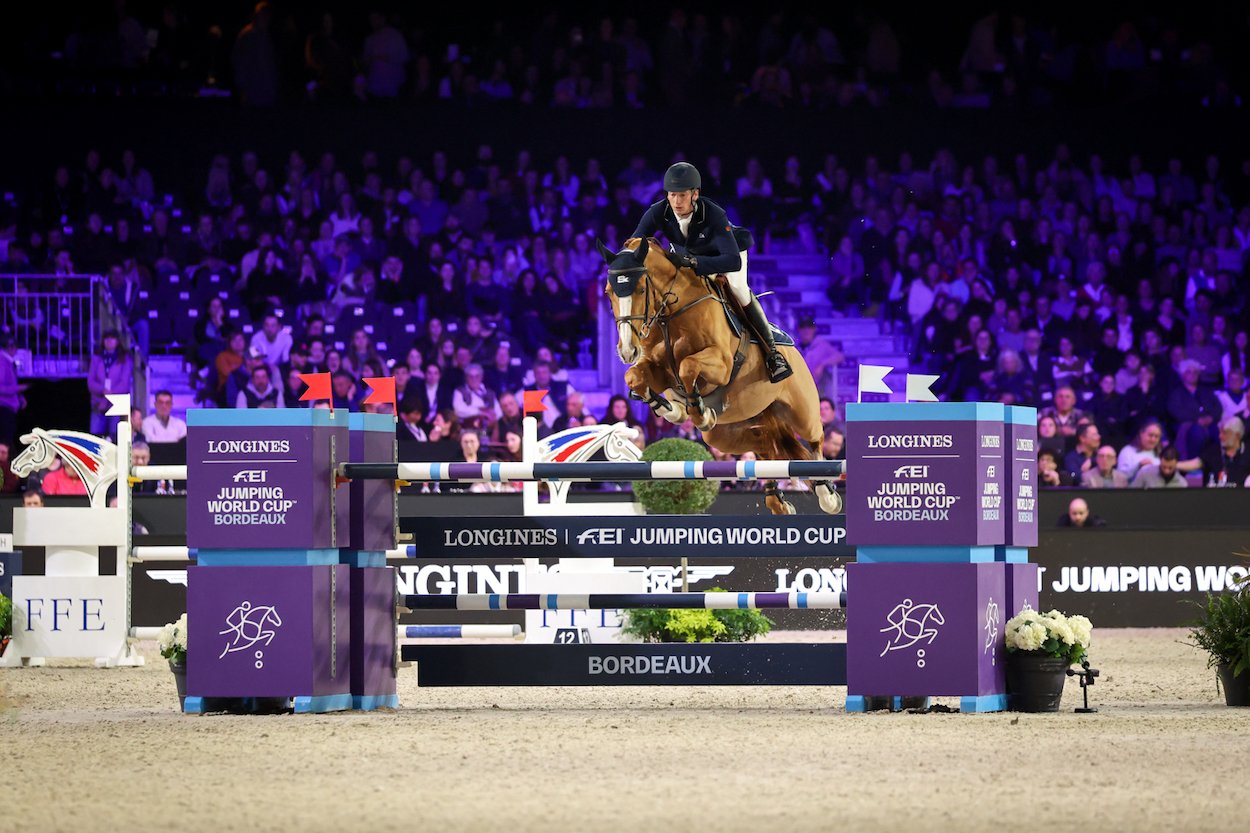
Daniel Deusser (GER) with Bingo Ste Hermelle.
Speaking afterwards, Epaillard was quick to credit his horse, describing Donatello as “very naturally fast” and praising his consistency in big indoor environments. Fresh from a Grand Prix win in Amsterdam, Donatello arrived in Bordeaux with minimal preparation, with Epaillard explaining that he travelled in on Wednesday, did light flatwork and a warm-up, and relied largely on the pair’s shared experience. “Now we have so much experience together, the horse feels in the ring like at home,” he said, adding that he felt “really happy, really proud” to be riding a horse who “always gives everything”.
The victory marked the third consecutive time Epaillard and Donatello have won this class, underlining both their speed and their familiarity with Bordeaux’s atmosphere. Yet despite the confidence boost, Epaillard remained pragmatic about what Friday represents in the wider context of the weekend, noting that a 1.50m class is not necessarily ideal preparation for a World Cup Grand Prix and that managing Donatello’s freshness for Saturday would now be key.
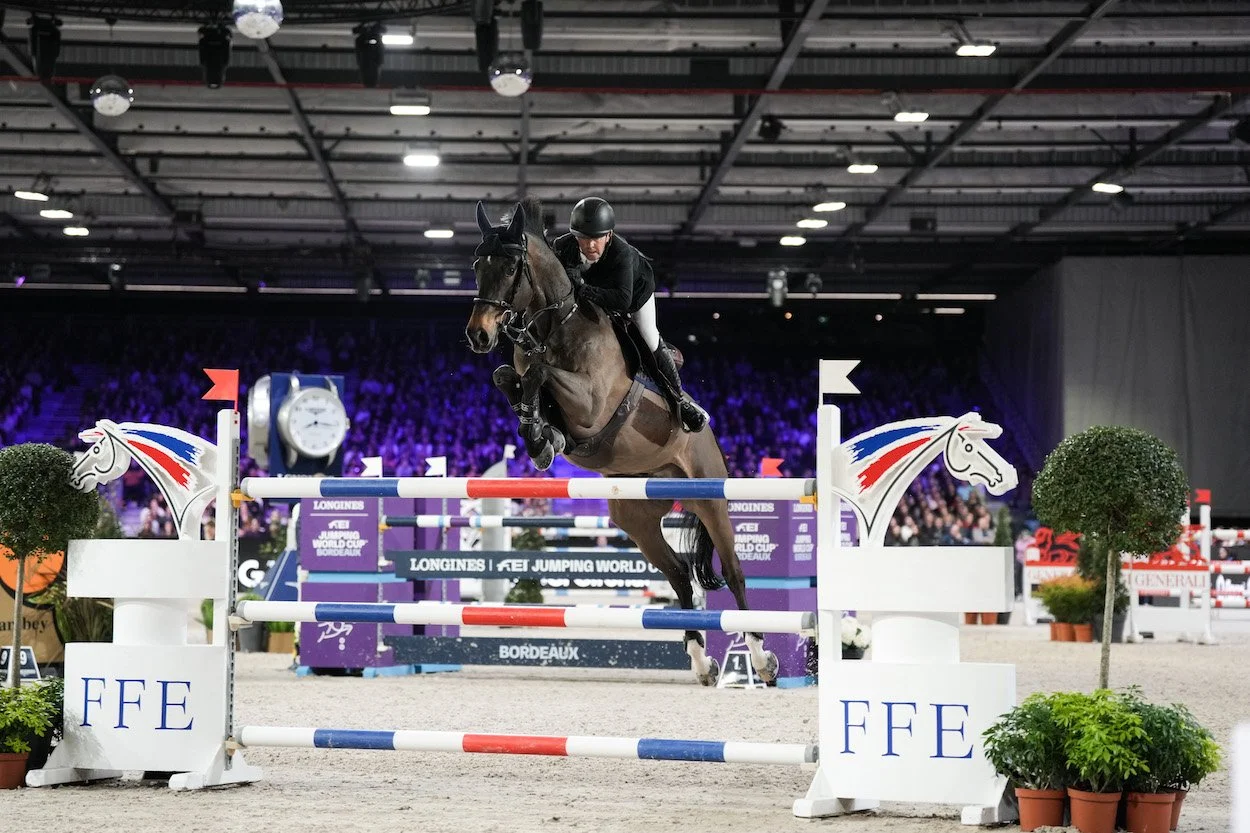
Marc Dilasser (FRA) claimed third place on Arioto du Gevres.
Beyond the placings, Friday began to separate combinations and clarify intent. Tactical choices became visible, early form started to emerge, and teams made final adjustments before points come into play. Some riders rode with ambition, others with restraint, protecting Saturday’s effort.
History, Pressure and Unfinished Business
The pressure of this event is amplified by timing within the Western European League. Bordeaux sits in the final stretch of qualification season, when margins tighten and scenarios become clearer. Riders are no longer speculating about points. They are calculating them. Interviews tend to sharpen accordingly, with combinations openly discussing strategy, risk appetite and contingency plans in ways that are often absent earlier in the circuit.
History adds another layer. Bordeaux is one of the founding venues of the World Cup series, having joined the inaugural season in 1978 to 79, and it has retained its prime-time stature ever since. Over decades, the arena has developed its own reputation: technically demanding courses, an engaged crowd, and a tendency to reward riders who commit fully rather than hedge their bets. Certain athletes have built long-term success here, while others continue to search for that elusive breakthrough round.
There is also the persistent “unfinished business” narrative attached specifically to Saturday night. Organisers continue to highlight that no female rider has yet claimed victory in Bordeaux’s Longines FEI Jumping World Cup Grand Prix, positioning it as one of the last major indoor classes still awaiting that milestone. Whether framed cautiously as an organiser statistic or embraced as a genuine historical tension, it gives the class an added layer of meaning, especially in a modern sport increasingly defined by depth across genders.