
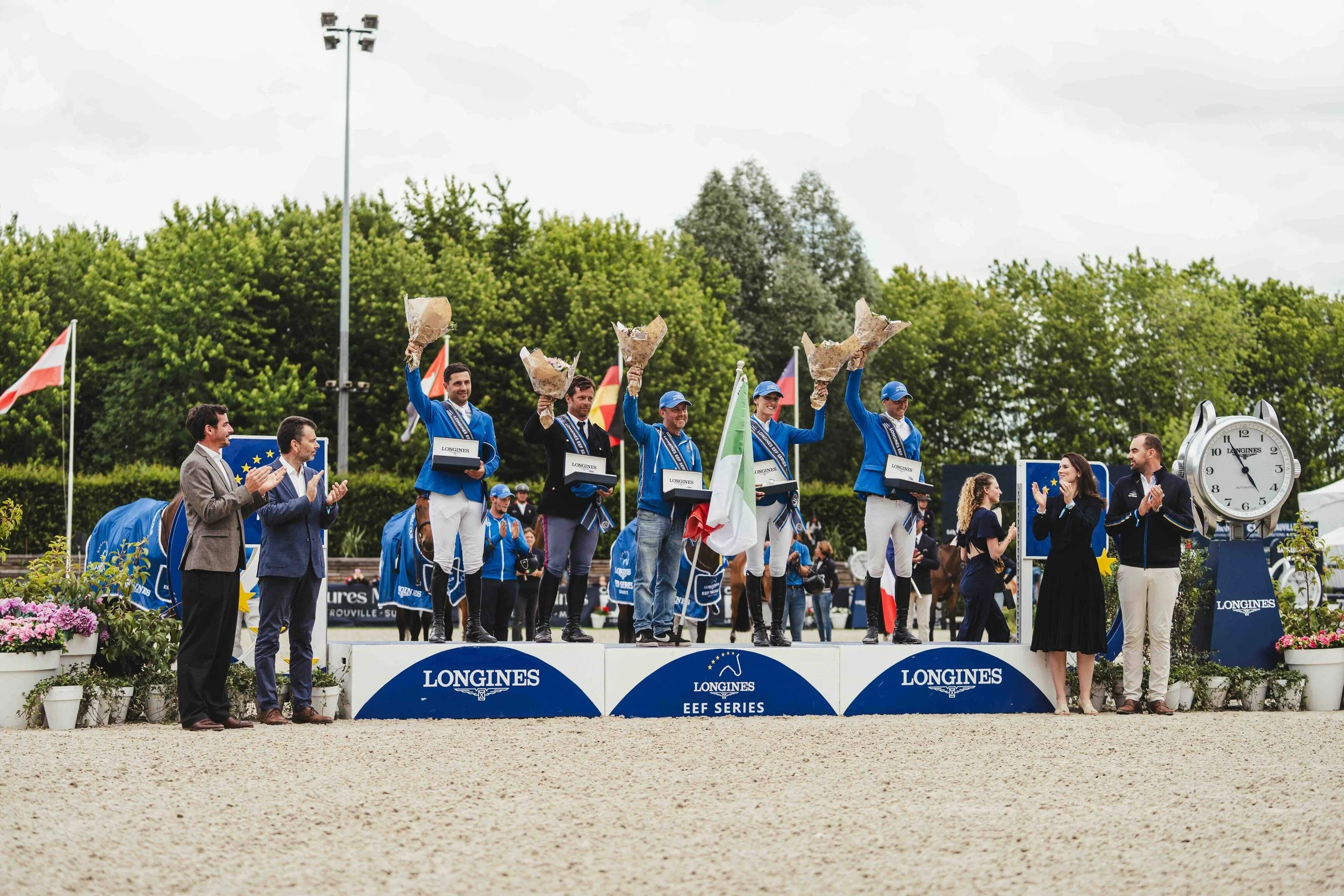
Team Italy : Filippo Tabarini, Federico Ciriesi, Matilde Giorgia Bianchi & Filippo Bassan, celebrate their victory at the Longines EEF Series CSIO3* in Deauville. Photo © EEF/Hippo Foto - Dirk Caremans.
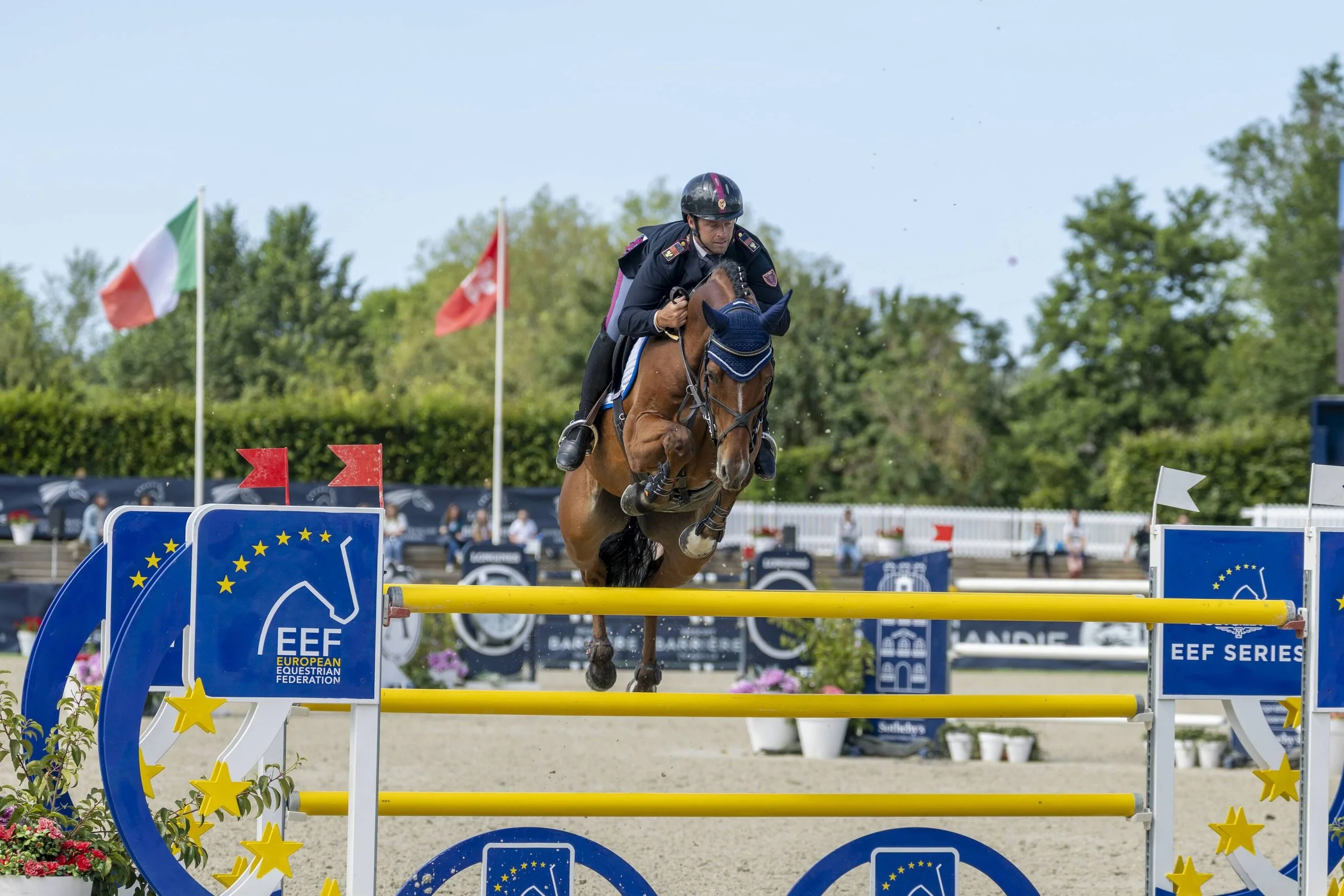
Federico Ciriesi & Quincy Juice jumped a double clear to secure the victory for Team Italy at the Longines EEF Series CSIO3* Deauville. Photo © EEF/Hippo Foto - Dirk Caremans.
Italy returned to winning ways at the second Region West qualifier in Deauville on Friday 5 June, taking victory on a two-round total of six faults ahead of Belgium in second and France in third.
Acting as both rider and Chef d'Équipe, Filippo Tabarini aboard Crème de la Crème Z led an Italian quartet completed by Federico Ciriesi on Quincy Juice, who jumped double clear, Filippo Bassan with Cerruti de Kreisker, who picked up just one time fault in the second round, and Matilde Giorgia Bianchi riding RR Carcom. Belgium climbed from fifth after the opening round into the runner-up spot behind clear second-round performances from Katja Haep on Romy FZ, who also finished double clear, and Constant Van Paesschen aboard Unaki de Bornival Z. France similarly rose from sixth to secure third on home ground, anchored by a double clear from Cédric Hurel with Fantasio Floreval Z and a second-round clear from Nina Mallevaey on Destine to Be.
The obvious question is what an Italian team was doing winning a Region West qualifier at all, and the answer is the most interesting structural feature of the whole Series.
Guests, Points and the Open Field
Nations may enter qualifiers outside their own region as guests. They compete for the win, they appear on the podium, and they score no points towards qualification, because points accrue only within a nation's own regional standings.
Italy, a Region South nation, therefore beat Belgium and France on the Normandy coast and gained nothing from it in competitive terms.
This produces a genuine tension in how the Series reads. Its purpose is regional development and progression, but its individual competitions are open, which means a strong nation can turn up anywhere and win. For the home teams, a visiting Italian side raises the standard of the week considerably. For the EEF, it keeps the qualifiers competitive rather than parochial. For a casual reader looking at a results table, it is baffling.
Belgium and France
Belgium's second place was their second podium in two Region West qualifiers, following the home win at Lier in May, and effectively sealed their progression to the Peelbergen semi-final, which they then won.
France's third on home ground was less comfortable than it looks. The French jumping programme had a significant 2026 elsewhere, winning the opening Longines League of Nations leg at Abu Dhabi in February, taking the Coupe des Nations Barrière at La Baule in June, and winning the final League of Nations qualifier at St Tropez-Gassin in September. Deauville sits a long way beneath all of that.
France did reach the Avenches Final through Peelbergen, and finished outside the medals.
Deauville's Place on the Calendar
The Normandy venue is one of the Series' established fixtures, and the EEF has made a point of building the calendar around a blend of this kind of traditional showground and newer sites. Deauville brings a coastal setting, an established audience and a region with deep breeding roots.
It also brings a scheduling problem. Deauville and Thessaloniki ran on exactly the same dates, 3 to 7 June, with their Nations Cups two days apart. Two qualifiers in one week across 3,000 kilometres is efficient for the calendar and awkward for anyone trying to cover the Series properly, which is part of why these competitions receive so little press attention relative to the number of nations they involve.
Italy won both.