Badminton begins this week, and for the first time since 2018 the most argued-about penalty in cross-country riding will carry a different price. Under the FEI Eventing Rules that came into force on 1 January 2026, a missed flag now costs nine penalties rather than fifteen.
That single change could alter the leaderboard at any five-star this year. Here is what the rule says, how it got here, and why it matters.
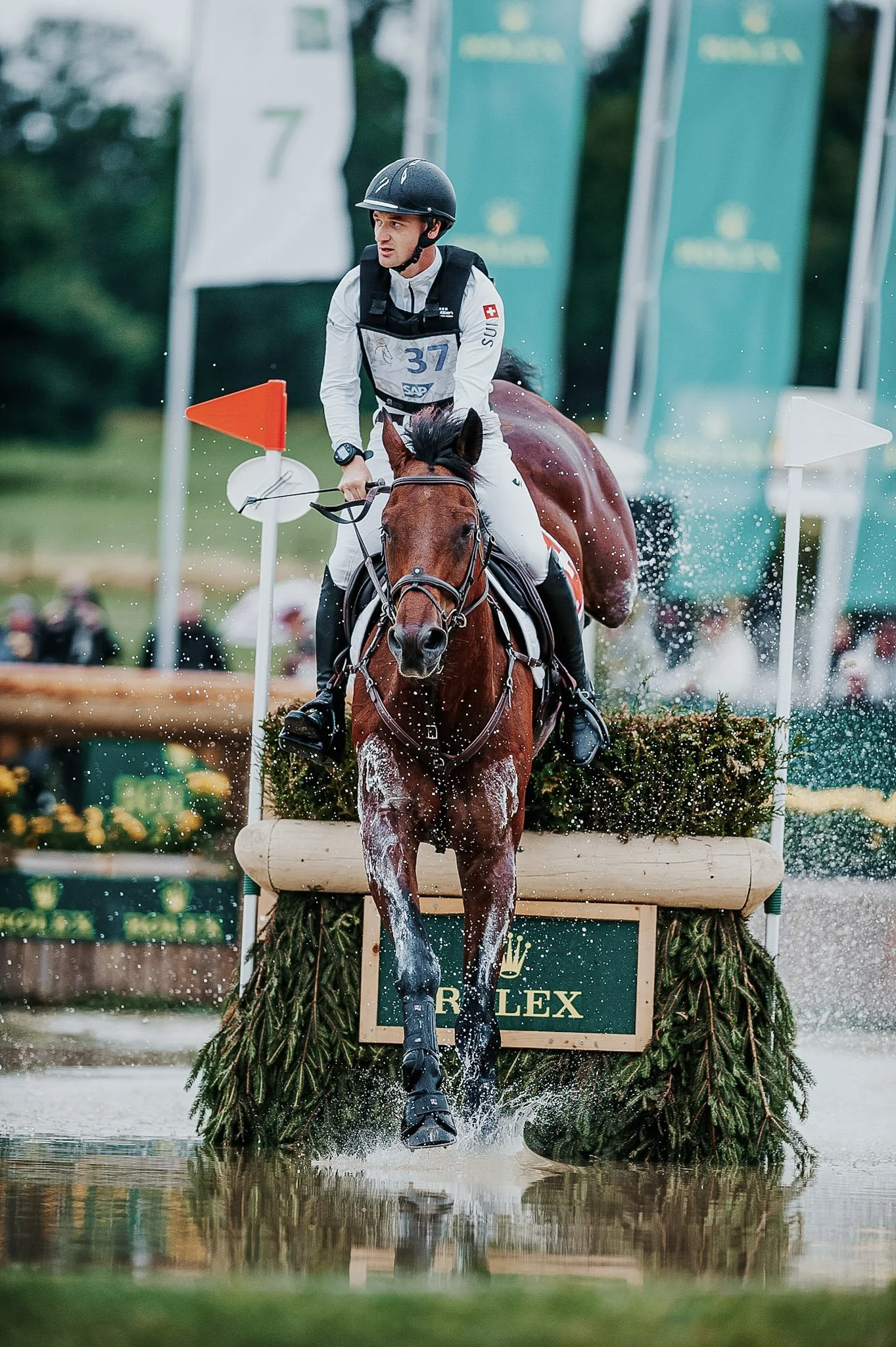
Robin Godel (SWI) and Grandeur de Lully CH during the Cross Country phase at the CHIO Aachen 2023. Image: © Tilly Berendt
What a Missed Flag Actually Is
Every cross-country obstacle is flagged: a red flag on the right, a white flag on the left. The flags mark the extremities of the jumping effort, and a horse is required to pass between them.
The difficulty comes with narrow fences, corners and angled questions, where a horse can jump the obstacle itself while part of its body travels outside the flagged line. The rules have to decide when that is a clear jump, when it is a run-out, and when it is something in between.
The current definition, in place since 2020, draws the lines as follows:
Clear: the horse's head, neck and the points of both shoulders pass between the flags. If a flag is dislodged, the hindquarters must still jump the height of the solid part of the obstacle.
Missed flag: the head and neck pass between the flags, but the point of one shoulder does not, while the horse still jumps the obstacle. This is the in-between case.
Run-out: the horse avoids the obstacle, so the head, neck and a shoulder point do not pass between the flags, or the hindquarters do not clear the solid height. A run-out costs 20 penalties, and a rider who continues without re-presenting is eliminated.
The legs do not count. The test is about the horse's body, not where its feet land.
How the Rule Got Here
The modern flag rule was introduced in 2018 with a 15-penalty sanction, and it was controversial almost immediately. The definition then in use was difficult to apply consistently from the ground, decisions arrived long after a round had finished, and several high-profile results were changed by a penalty that riders, officials and spectators struggled to see with the naked eye.
The FEI issued a clarification in 2019 describing a missed flag as a horse jumping the fence with the majority of its body inside the flags, and then rewrote the definition for 2020 around the head, neck and shoulders, as set out above. That made the rule clearer. It did not resolve the underlying complaint, which was that 15 penalties was a severe price for a horse that had, by any common-sense measure, jumped the fence.
What Changed for 2026
The 2026 Eventing Rules were fully restructured, with penalties now grouped by severity and set out together in a single annex. Within that revision, Article 548.1 reduces the missed flag penalty from 15 to 9. The rules were approved at the FEI General Assembly in Hong Kong in November 2025.
The new value has been placed deliberately. Nine penalties sits below the 11 penalties for activating a frangible device and above the eight penalties for knocking down two fences in the jumping test. That ordering reflects a judgement about seriousness: a horse that triggers a frangible device has hit a fence hard enough to collapse it, which is a greater safety concern than a horse that jumps a narrow fence slightly off line.
The run-out penalty of 20 is unchanged, as are the 40 penalties for a second refusal at the same obstacle and elimination for a third.

Christoph Wahler (GER) and Gainsbourg de Bedon during the Cross Country for the FEI Eventing Nations Cup™ Final at Military Boekelo 2026. Image: ©Libby Law Photography
Why the Change Matters
Fifteen penalties was enough to remove a rider from contention at almost any five-star. Leading scores after dressage at Badminton and Burghley routinely sit in the low twenties, and the margin between first and tenth after cross-country is often smaller than 15. A single flag decision could therefore move a combination from the podium to the middle of the field.
At nine, a missed flag is still costly but no longer decisive on its own. A rider with a strong dressage score and a clear jumping round can now absorb one and remain competitive. That is closer to the scale of the error, and it lowers the pressure on officials to be certain about a decision taken in a fraction of a second.
There is a second effect that matters for horse welfare. When a missed flag cost almost as much as a run-out, there was a reasonable argument that riders were incentivised to force a tired horse through a narrow question rather than circle and re-present. A smaller penalty for a marginal line reduces that pressure, though it does not remove it.
How Decisions Are Made
Flag decisions start with the fence judge, who records what they see at the obstacle. The decision is ultimately taken by the Ground Jury, and at the major events, where fences are filmed, footage can inform the outcome.
That process is why missed flag penalties often appear on the scoreboard some time after a round has finished, and why provisional results on cross-country day should be read as provisional. A rider who has been given a missed flag can ask for the decision to be reviewed.
What to Watch at Badminton

Cross Country phase during the Asian Games 2026. Image: ©M. Froment for Equerry Co.
Five-star tracks always include several narrow and angled questions late on the course, when horses are tiring and the margin for error on line is smallest. Those are the fences where flag decisions are made.
Three things are worth keeping in mind on cross-country day.
The first is that a rider who appears clear on the live feed may not be. Wait for the confirmed scores.
The second is that nine penalties will now be recoverable for a rider in the top five after dressage, which was rarely true under the old rule.
The third is that the 2026 rule is new to everyone. Officials, riders and coaches are applying it at five-star level for the first time this season, and how consistently it is applied at Badminton will shape how it is talked about for the rest of the year.
The Penalties in One Place
For reference, the main cross-country penalties under the 2026 FEI Eventing Rules are:
First refusal, run-out or circle at an obstacle: 20 penalties
Second refusal at the same obstacle: 40 penalties
Third refusal at the same obstacle: elimination
Missed flag: 9 penalties (previously 15)
Activating a frangible device: 11 penalties
Exceeding the optimum time: 0.4 penalties for every second over
Fall of horse or rider: elimination
Badminton runs from 6 to 10 May, with cross-country on Saturday 9 May.