Show jumping is among the easiest sports in the world to enjoy without understanding and among the hardest to follow properly without someone explaining the vocabulary. A commentator can say that a rider has taken a flyer at the oxer, added a stride to the combination and picked up a time fault, and a newcomer will have grasped roughly none of it while watching exactly the same round as everybody else.
Here is the language, and what each term is actually describing.
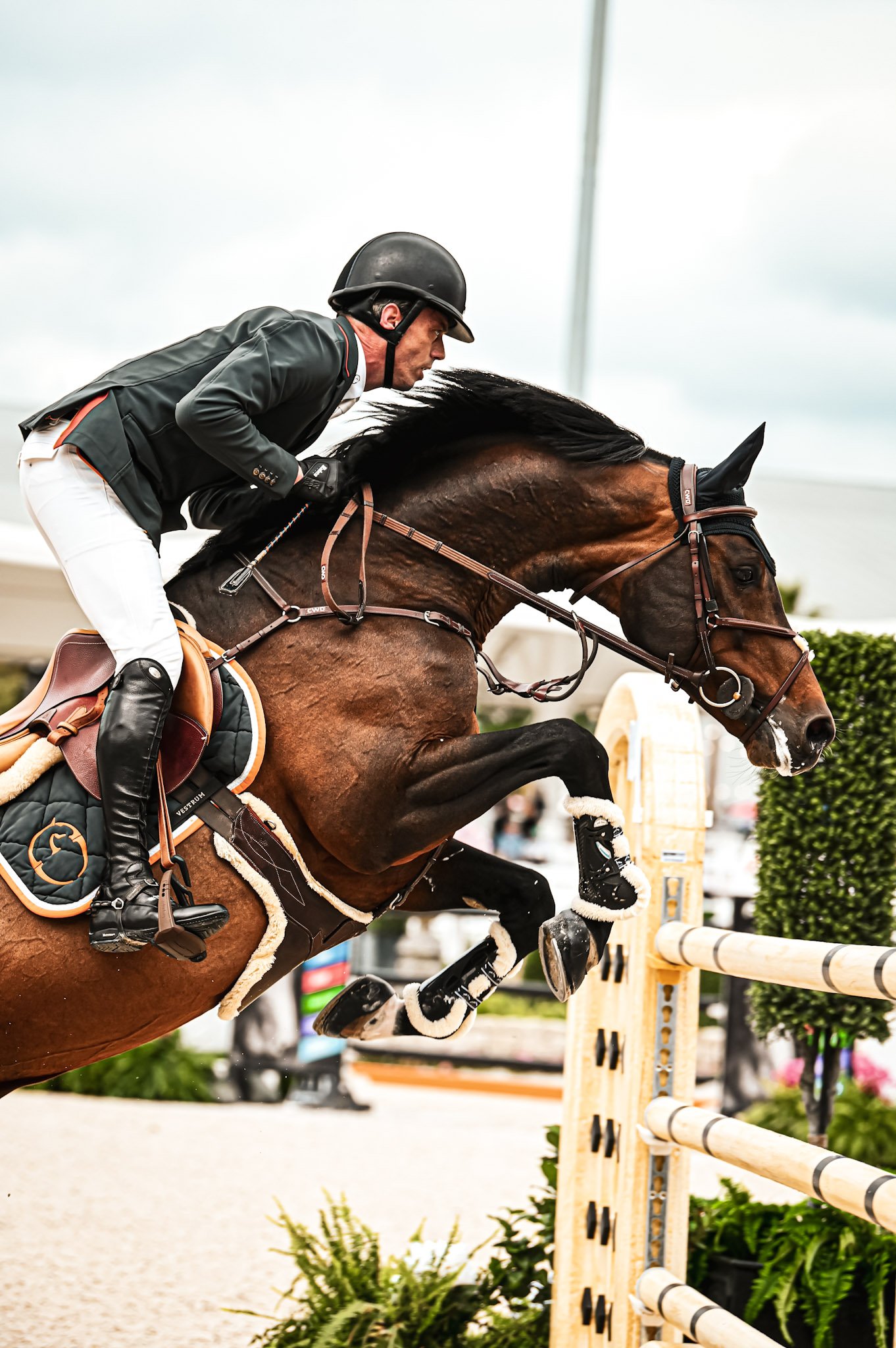
Harrie Smolders and Uricas vd Kattevennen during the Longines League of Nations in Ocala, 2024. ©M. Froment for Equerry Co.
How a Round Is Scored
A clear round, sometimes called a clean round, is one completed inside the time allowed without a single jumping fault. When two or more combinations manage it, the class is settled by a jump-off: a shortened version of the course, ridden against the clock, in which the winner is whoever accumulates the fewest faults in the fastest time.
A knockdown occurs when a horse or rider alters the height or the width of an obstacle. That means a pole that falls out of its cup at the back of an oxer counts exactly as much as one that falls at the front. Four faults, every time.
A refusal is a stop or a run-out on the approach, and the penalty structure escalates sharply. The first costs four faults. The second ends the round in elimination.
Off course means the rider has departed from the sequence or the direction set by the course designer, which is less forgiving than it sounds, because the designer publishes that sequence before the competition and the rider has walked it.
A voluntary retirement is the rider's own decision to stop, usually because the horse has picked up an injury, because the course is going badly enough that continuing serves no purpose, or because the faults already accumulated have put a placing out of reach. It is a deliberate choice, and increasingly a respected one.
The Clock
Every course carries a time allowed, calculated from a required pace, typically 350 metres per minute indoors or at lower levels, rising to 400 metres per minute in top-level outdoor competition, across the measured distance of the track.
The penalty for exceeding it differs between phases, and the difference matters enormously. In a first round, a rider picks up one fault for every four seconds over the time allowed. In a jump-off, it is one fault for every single second.
That is why jump-offs look the way they do. The margin between winning and finishing fourth is routinely under half a second, and a rider who takes an extra stride anywhere has usually given the class away.
What the Rider Is Thinking About
A stride is one galloping step. The average horse covers about twelve feet, or 3.65 metres, in one, but that figure is an average rather than a rule, and a rider's single most important piece of knowledge is exactly how far their own horse covers.
That number governs everything, because the distances between fences are built to be ridden in a set number of strides. A horse with a long stride and a rider who has not adjusted for it arrives at the second element of a combination too close. A short-striding horse and the same track requires the rider to push forward for seven strides where another combination will comfortably fit six.
The takeoff point is where all of that arithmetic resolves. Get the horse to the correct spot and the fence looks straightforward. Leave from too far away and the horse lands early, catching the rail behind. Get too close and the front legs come up into the pole on the way out of the ground.
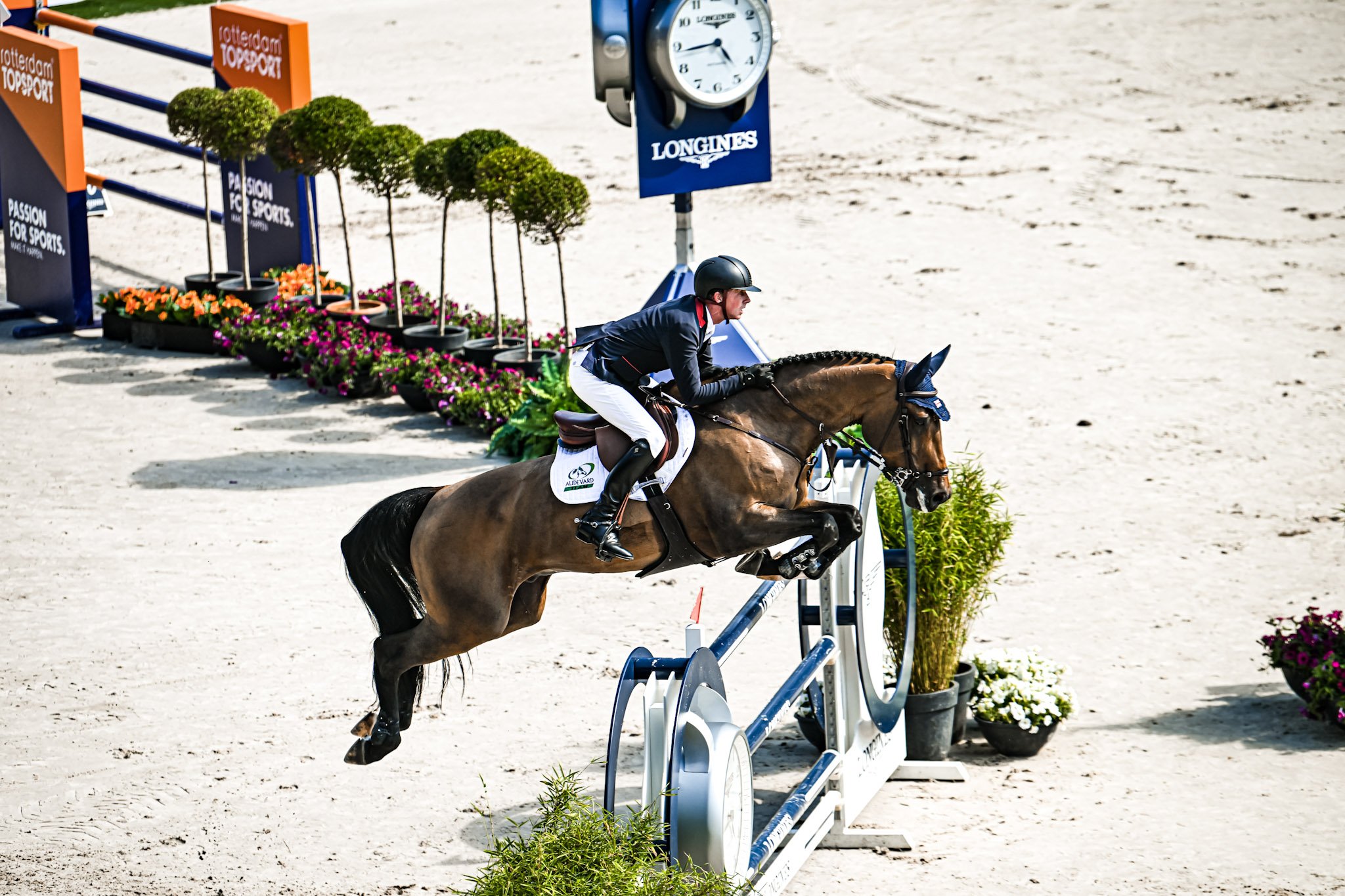
Ben Maher and Point Break at CHIO Rotterdam 2026. ©M. Froment for Equerry Co.
Before Anybody Jumps Anything
Walking the course is the part of the day that spectators see and rarely think about, and it is the single most important twenty minutes of a rider's competition.
Riders are allowed onto the course on foot, and that is the only time they are permitted there before they compete. The horses never see it at all. They arrive at the first fence having had no preview whatsoever, something to remember the next time a young horse looks hesitant at a brightly painted obstacle.
The rider paces out every distance between fences and works out how to adjust the horse's stride to meet each one. They register what type each obstacle is, how the fences relate to one another, what the footing is doing, and where the trouble is likely to come. In a speed class or a jump-off they are also looking for the shorter route, the inside turn that saves the half-second that decides it.
The Fences Themselves
A rail is the pole or plank that sits in the cups, and the specification is tighter than most people assume. Under international rules, poles measure between 8 and 10 centimetres (roughly 3 to 4 inches) in diameter and typically span 3 to 3.6 metres (10 to 12 feet) across, though narrower "skinny" fences are often used to test a rider's accuracy.
Who Goes When
The order of go is arrived at in one of two ways. A seeded order ranks competitors by how they have performed earlier in the week, which tends to load the best combinations towards the end of the class. A random draw gives every competitor the same chance of an advantageous slot.
It is not a trivial distinction. Going late in a jump-off means knowing exactly what the target is. Going first means setting it blind.
If you want to know what the course designer was doing while all this was being measured out, our guide to how a track is built is here, and our explainer on the different competition formats covers everything from the Derby to the Puissance.