The updated text below incorporates the corrected Mannheim dates (29 April to 5 May), clarifies the point-redistribution nuance when a guest nation wins a qualifier, and refines the Final host eligibility phrasing while preserving your original voice and flow.
The sixth season of the Longines EEF Series opens this week in Mannheim, and over the next four months it will put more European nations into Nations Cup competition than any other team series in the sport. It is also the series most often misunderstood, because it does not work like the Nations Cups most readers know.
This is how it works.
© Longines EEF Series
What the EEF Series Is For
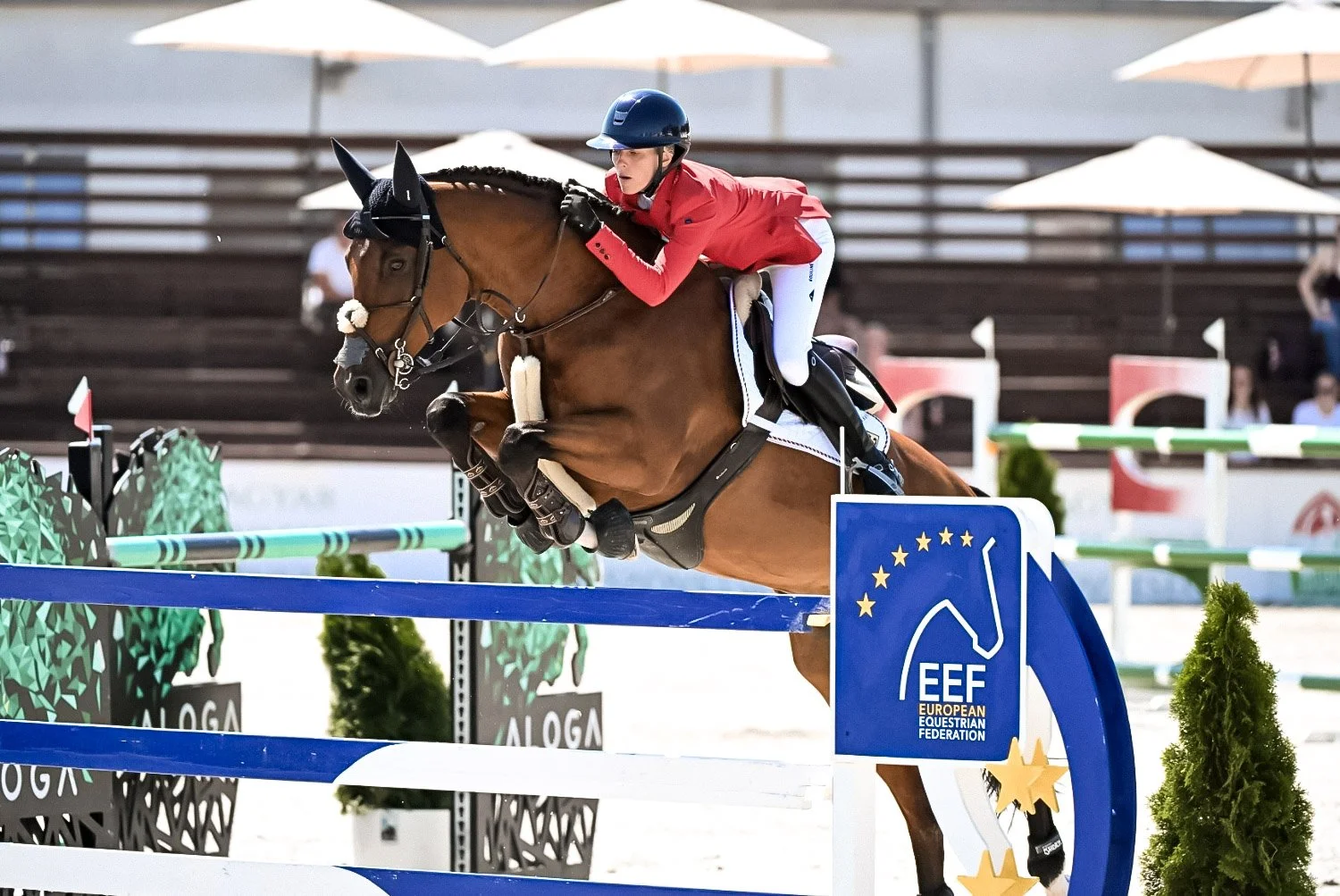
The Longines EEF Series is run by the European Equestrian Federation, the umbrella body for Europe's national federations, rather than by the FEI. Its purpose is explicitly developmental: to put young riders, young horses and smaller federations into a structured team environment, with a flag and a score that counts, several years before most of them would be considered for a five-star Nations Cup.
That purpose shapes everything else. The qualifiers run at CSIO3* level, the semi-finals at CSIO3*, and the Final at CSIO4*. Courses are built to test precision and stamina rather than raw scope, and the field is wider than at any other team competition in Europe.
The Four Regions
Europe is divided into four regions, and every EEF member nation belongs to one of them.
Region North (10 nations): Denmark, Estonia, Finland, Iceland, Israel, Latvia, Lithuania, Norway, Poland and Sweden.
Region West (8 nations): Andorra, Belgium, France, Great Britain, Ireland, Luxembourg, Portugal and Spain.
Region Central (9 nations): Austria, the Czech Republic, Germany, Hungary, Liechtenstein, the Netherlands, Slovakia, Slovenia and Switzerland.
Region South (15 nations): Albania, Bosnia and Herzegovina, Bulgaria, Croatia, Cyprus, Greece, Italy, Malta, Monaco, North Macedonia, Romania, San Marino, Serbia, Turkey and Ukraine.
The regions are not equal in strength, and they are not meant to be. Region Central contains Germany, the Netherlands and Switzerland. Region South contains Italy, three-time Series champions, alongside federations for whom a CSIO3* Nations Cup is the highest level of team sport they will contest all year.
The 2026 Qualifiers
Each region holds two CSIO3* qualifiers between April and June, which makes eight in total:
Region Central: Mannheim, Germany (29 April to 5 May) and Budapest, Hungary (24 to 28 June)
Region West: Lier, Belgium (6 to 10 May) and Deauville, France (3 to 7 June)
Region South: Scuderia La Caccia, Borgo la Caccia, Bedizzole, Italy (13 to 17 May, a new venue this year) and Thessaloniki, Greece (3 to 7 June)
Region North: Stutteri Ask, Martofte, Denmark (20 to 24 May) and Drammen, Norway (10 to 14 June)
Deauville and Thessaloniki share a week, which means two Nations Cups on the same weekend, 3,000 kilometres apart.
How a Qualifier Is Jumped
© Longines EEF Series
The format will be familiar to anyone who follows Nations Cup jumping. Two rounds are jumped over identical courses, both against the clock under Table A. Each team fields four riders per round, and the three best scores count. A team eliminated, retired or withdrawn in the first round cannot start in the second.
If teams are level on penalties for first place after two rounds, a jump-off decides it, with one rider per team. Lower placings are separated by the combined second-round times of each team's best three riders.
Points, and Why You Must Start Twice
Each qualifier awards points on a fixed scale: 100 for first, 90 for second, 80 for third, then 70, 60, 55, 50, 45, 40 and 35 down to tenth place. Every team finishing eleventh or lower receives 30.
Points from a nation's two regional qualifiers are added together to produce the regional standings. Teams must compete in both qualifiers in their own region to earn points at all, which is the rule that stops a federation from cherry-picking the fixture that suits it.
If two nations finish level, the result at the higher-level qualifier takes precedence, or the result at the second qualifier if both are at the same level.
The Guest-Nation Rule
This is the part that confuses results tables every summer.
Nations are not confined to their own region. A team can start at a qualifier elsewhere in Europe as a guest—via an Organising Committee invitation or an FEI Wild Card—and it competes for the result on the day like everyone else: it can win the class and stand on the podium. What it cannot do is collect qualification points from that competition, because the regional standings are built only from a nation's results in its own region.
The effect is that you will occasionally see a qualifier won by a team that gains nothing in the standings from winning it, while the home-region teams behind it move up to claim the full allocation of qualification points—meaning a regional team finishing second on the day behind a guest winner still banks the 100 first-place points. For the home teams, a strong visiting side lifts the standard of the week. For the Series, it keeps qualifiers competitive rather than parochial. For anyone reading a results table without context, it looks like an error. It is not.
The same principle extends to the later rounds. The host nation of a semi-final may enter as an additional team if it has not already qualified, and up to two invited teams from outside the EEF can start at a semi-final, but neither route leads to the Final.
© Longines EEF Series
The Semi-Finals
The top five teams from each region go through to one of two CSIO3* semi-finals, pairing the regions together:
Regions West and North: Peelbergen, the Netherlands (2 to 5 July). Peelbergen holds the contract for this semi-final until 2030.
Regions South and Central: Šamorín, Slovakia (8 to 12 July), at the X-Bionic Sphere.
Each semi-final therefore brings ten qualified nations together, plus any host or invited teams, competing for five places in the Final.
The Final
The five best eligible teams from each semi-final, ten in total, go to the Final, a CSIO4* at the Institut Équestre National d'Avenches in Switzerland, from 3 to 6 September. The Final is jumped over two rounds, and the hosts may join as an additional eleventh team provided they competed in their regional qualifiers (and semi-final, if qualified) without advancing through the normal pathway.
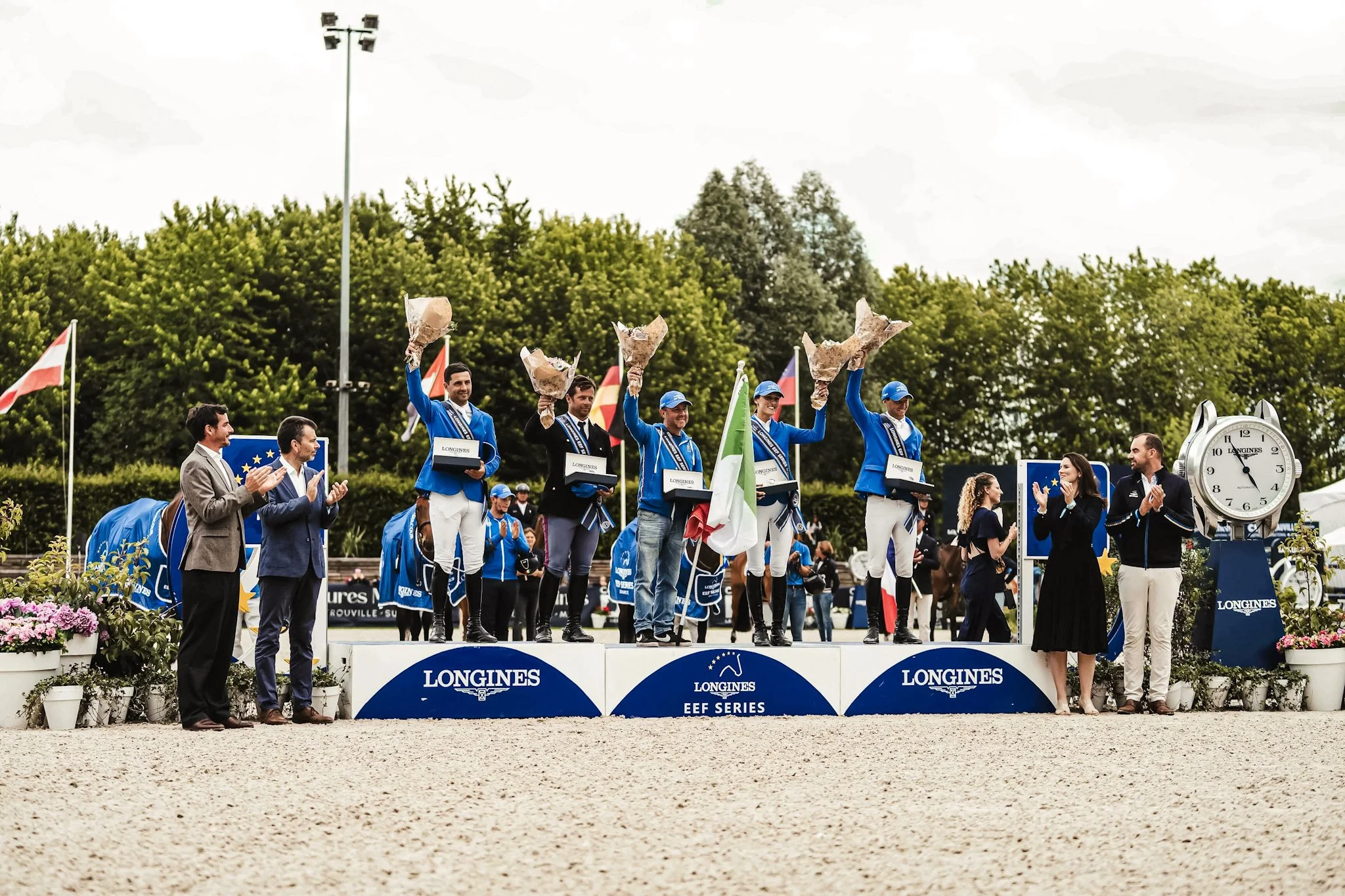
Switzerland are the defending champions, having won the inaugural Avenches Final in September 2025 through a decisive round from Gaëtan Joliat and Chelsea Z. Italy, with three titles, remain the Series' most successful nation.
What to Watch This Season
Three things will shape the 2026 Series.
The first is how nations use it. There is a genuine split between federations that treat the Series as a development platform, blooding young horses and first-time team riders, and those that bring experienced combinations to bank points early. Both approaches are legitimate. Only one of them is what the Series was designed for, and the results tend to reward the other.
The second is the calendar. Avenches falls in the same week as Burghley, which will matter to how much attention the Final receives in Britain.
The third is Region Central. With Germany, the Netherlands, Switzerland and Austria competing for five semi-final places from a nine-nation region, the qualifiers at Mannheim and Budapest will be as competitive as any Nations Cup in Europe below five-star level.
The Series begins in Mannheim this week, with the Nations Cup taking place on Sunday.