The eventing at the FEI World Championships begins in Aachen tomorrow, and over five days the scoreboard will carry numbers that look simple and are not. Why does a dressage mark of 77% become 23.0? How can a rider who jumps every fence still lose 20 penalties? And what does it mean to finish on your dressage score?
This is how eventing is scored.
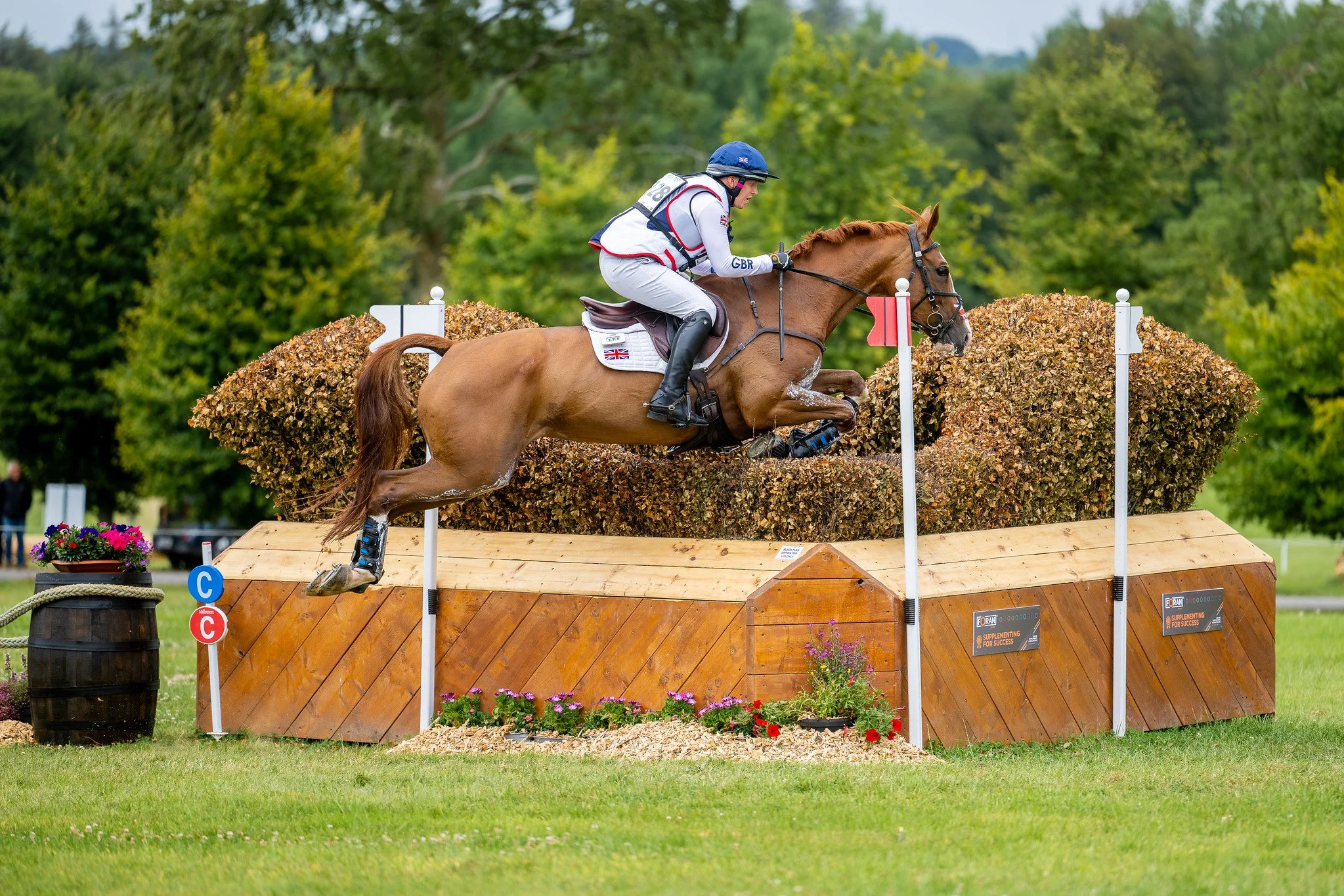
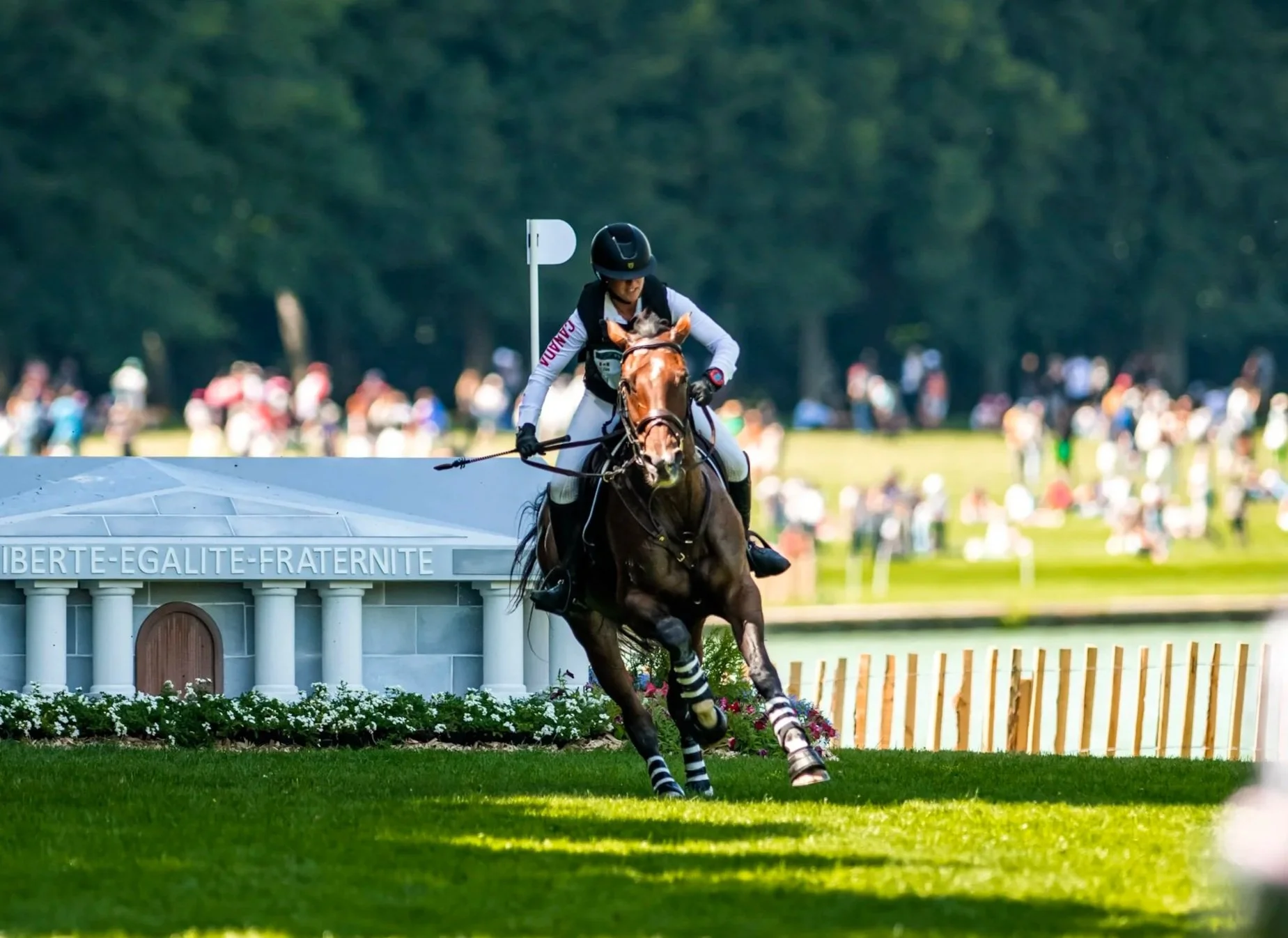
Tom Bird (GBR) rides Lenny during the Cross Country Phase at the FEI Eventing World Championship U25 2026. Image: ©FEI/Benjamin Clark
The Basic Principle
Eventing is scored in penalties, and the lowest total wins. Each of the three tests, dressage, cross-country, and jumping, adds penalties to a running total, and the combination with the fewest at the end is the winner.
That sounds obvious, but it changes how you read a leaderboard. In dressage, a higher percentage is better. In eventing, that percentage is converted into penalties, so a lower number is better, and every subsequent phase can only add to it.
Dressage: From Percentage to Penalties
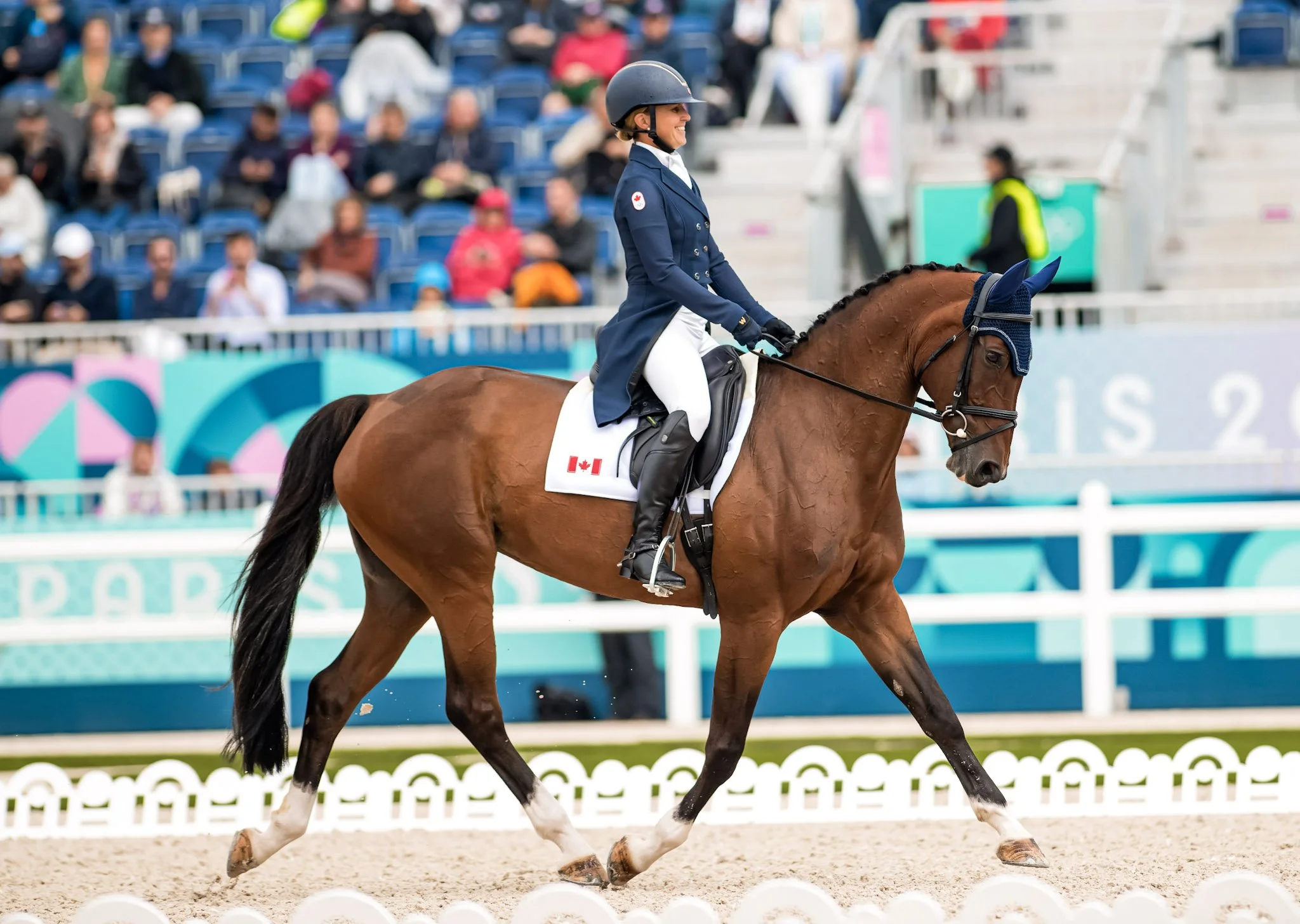
Jessica Phoenix and Freedom GS during the dressage phase at the Paris 2024 Olympic Games. Image: ©C. Grimshaw for EquerryCo.
Eventing dressage is judged in the same way as pure dressage. Each movement is marked out of ten by the judges, collective marks are added, and the result is expressed as a percentage.
That percentage is then converted into penalties by subtracting it from 100. A test scored at 77% becomes 23.0 penalties. A test at 70% becomes 30.0. A test at 80%, which would be exceptional, becomes 20.0.
As a rough guide at the top level, a dressage score below 25 puts a combination in contention, below 30 is competitive, and anything in the high thirties means the rider will need others to make mistakes.
Since 2026, at CCI4* championships and above, the judges' marks for flying changes, halts, rein-backs, and walk pirouettes are reviewed against video if two judges differ by three points or more on the same movement. That rule exists because a single outlying mark can move a combination several places in a discipline where the leading scores are separated by fractions.
Cross-Country: Where the Competition Is Decided
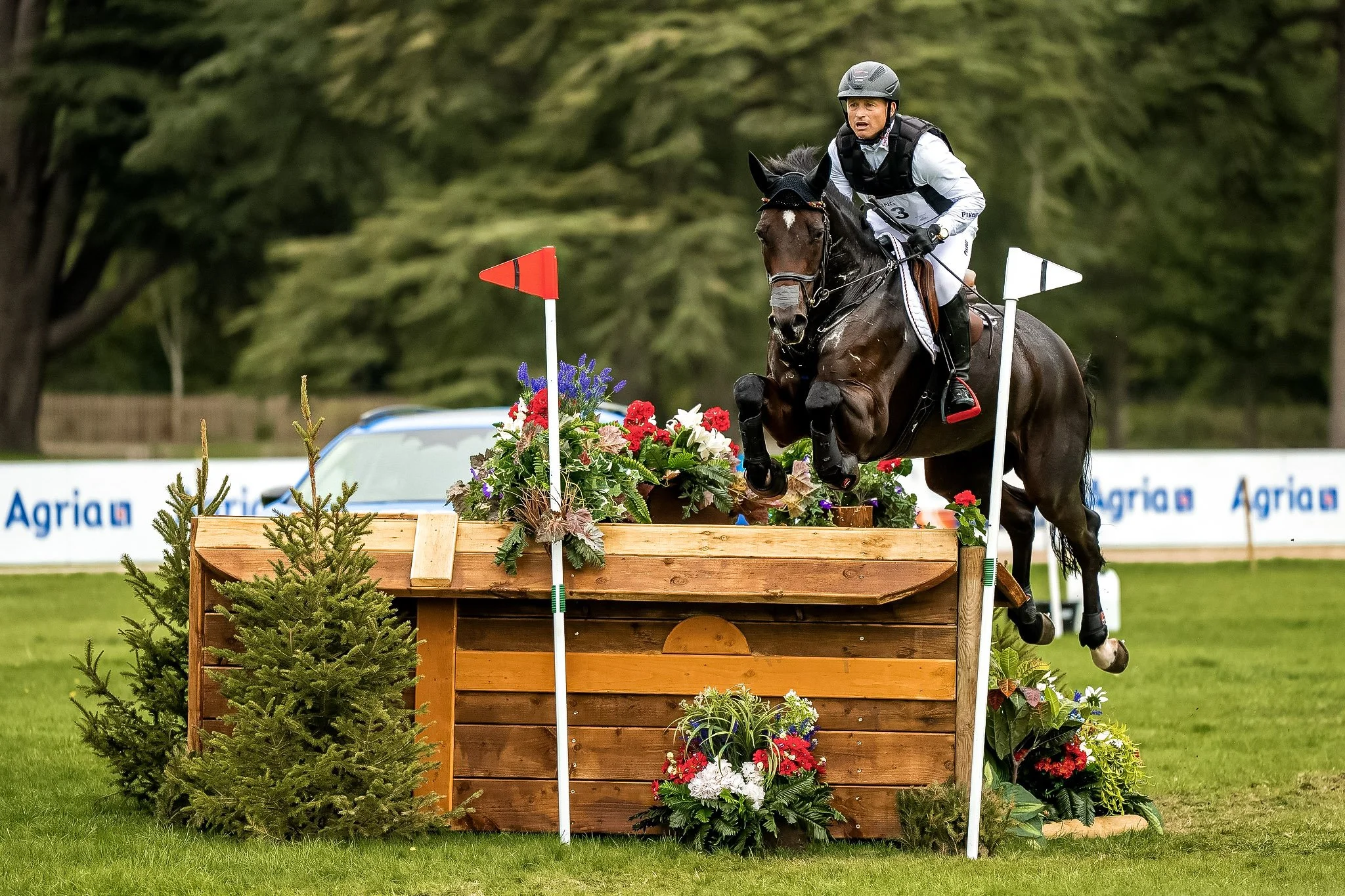
Michael Jung (GER) and Fischerchipmunk FRH during the Cross Country Phase for the CH-EU-CCI4*-L at the Agria FEI Eventing European Championship Blenheim Palace 2025. Image: ©FEI/Benjamin Clark
The cross-country is the phase that defines eventing, and it is scored in two ways: jumping penalties and time penalties.
Jumping penalties are incurred for disobediences and errors at the obstacles:
A first refusal, run-out, or circle at an obstacle: 20 penalties
A second refusal at the same obstacle: 40 penalties
A third refusal at the same obstacle (or a fourth across the entire course): elimination
A missed flag, where the horse jumps the fence but a shoulder passes outside the flagged line: 9 penalties under the 2026 rules, reduced from 15
Activating a frangible device, where a fence is designed to collapse if hit hard: 11 penalties
A fall of horse or rider: elimination
Time penalties are calculated against the optimum time, which is set by the course length and the required speed. Every second over the optimum time costs 0.4 penalties. A combination that finishes 20 seconds over the time adds 8 penalties, which is the equivalent of two fences down in the jumping.
This is where most championships are won and lost. A clear round inside the time adds nothing. A clear round 25 seconds over the time adds 10. Two riders who have both jumped every fence can be separated by more than the margin of the entire dressage phase.
Jumping: The Final Test
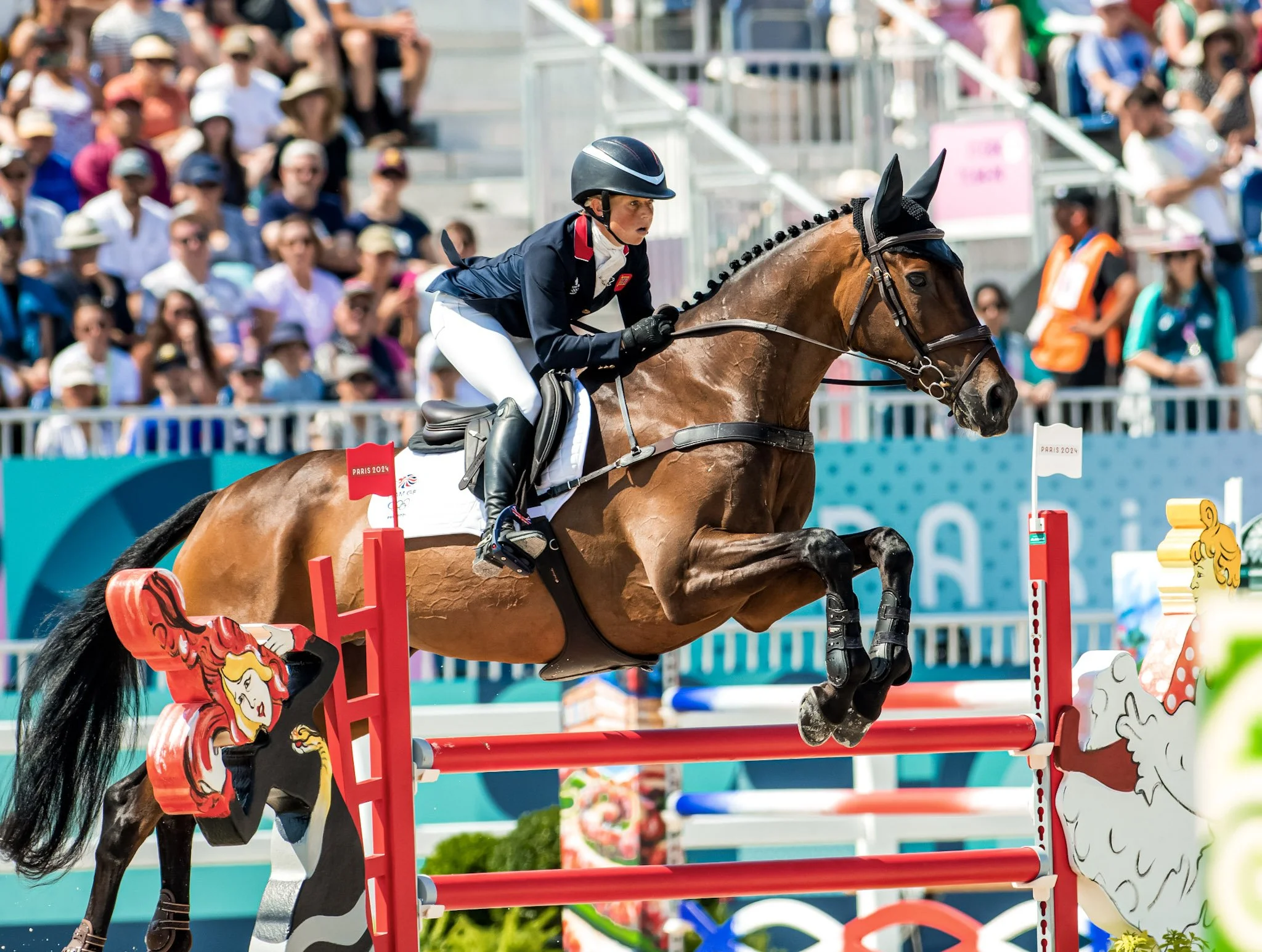
Ros Canter and Lorships Graffalo during the jumping phase at the Paris 2024 Olympic Games. Image: ©C. Grimshaw for EquerryCo.
The jumping test comes last, after the horses have run the cross-country, and its purpose is to show that a horse is still fit, supple, and obedient the day after the most demanding test of the competition.
Each fence knocked down: 4 penalties
A first disobedience: 4 penalties
A second disobedience: elimination
A fall: elimination
Exceeding the time allowed: 1 penalty for each second or part of a second over
Courses at championship level are built to be fair but testing for a horse that galloped the day before, and the order is reversed so that the leaders jump last. That is why the final round of an eventing championship so often decides the medals.
Finishing on Your Dressage Score
You will hear this phrase constantly in Aachen. A combination finishes on its dressage score when it adds nothing in the cross-country and nothing in the jumping: no jumping penalties, no time penalties, no fences down.
It is the eventing equivalent of a perfect round, and it is extremely difficult to achieve at championship level. A rider who leads after dressage and finishes on that score is almost impossible to beat. A rider who finishes on a dressage score of 23.0 has produced, across three different tests, as close to a faultless competition as the sport allows.
Teams
At a World Championship, nations field teams of up to four combinations, with the best three scores counting towards the team total. If one team member is eliminated or retires, the remaining three must all count, which leaves no margin for a further mistake.
Individual and team competitions run concurrently, so every rider on a team is competing for both at once.
Short and Long Formats
At international level, competitions are graded from one star to five stars, and run in two formats. A CCI-S, or short format, is the shorter test, typically run over fewer days with a shorter cross-country course. A CCI-L, or long format, has a longer cross-country course and is the format of the great five-star events such as Badminton, Burghley, and Kentucky.
What to Watch for in Aachen
Three things will tell you how the eventing is unfolding.
After dressage, look at the gap between the leaders, not just the order. A lead of two or three penalties is less than eight seconds over the optimum time on the cross-country.
On cross-country day, watch the clock as closely as the fences. The riders who finish inside the optimum time are the ones who will be in contention on Sunday.
On the final day, count the fences down. With the leading scores separated by fractions, a single rail can decide a medal, and frequently does.
The eventing dressage begins on Wednesday 12 August, with cross-country on Saturday 15 August and the jumping test on Sunday 16 August.