Para dressage is the equestrian discipline most often watched without being understood. Viewers can see that something is being judged and that the horses are beautiful, and frequently have no idea what separates a Grade I test from a Grade V one, or why two riders doing visibly different things can both be world champions.
Here is what is actually happening.
The Grades
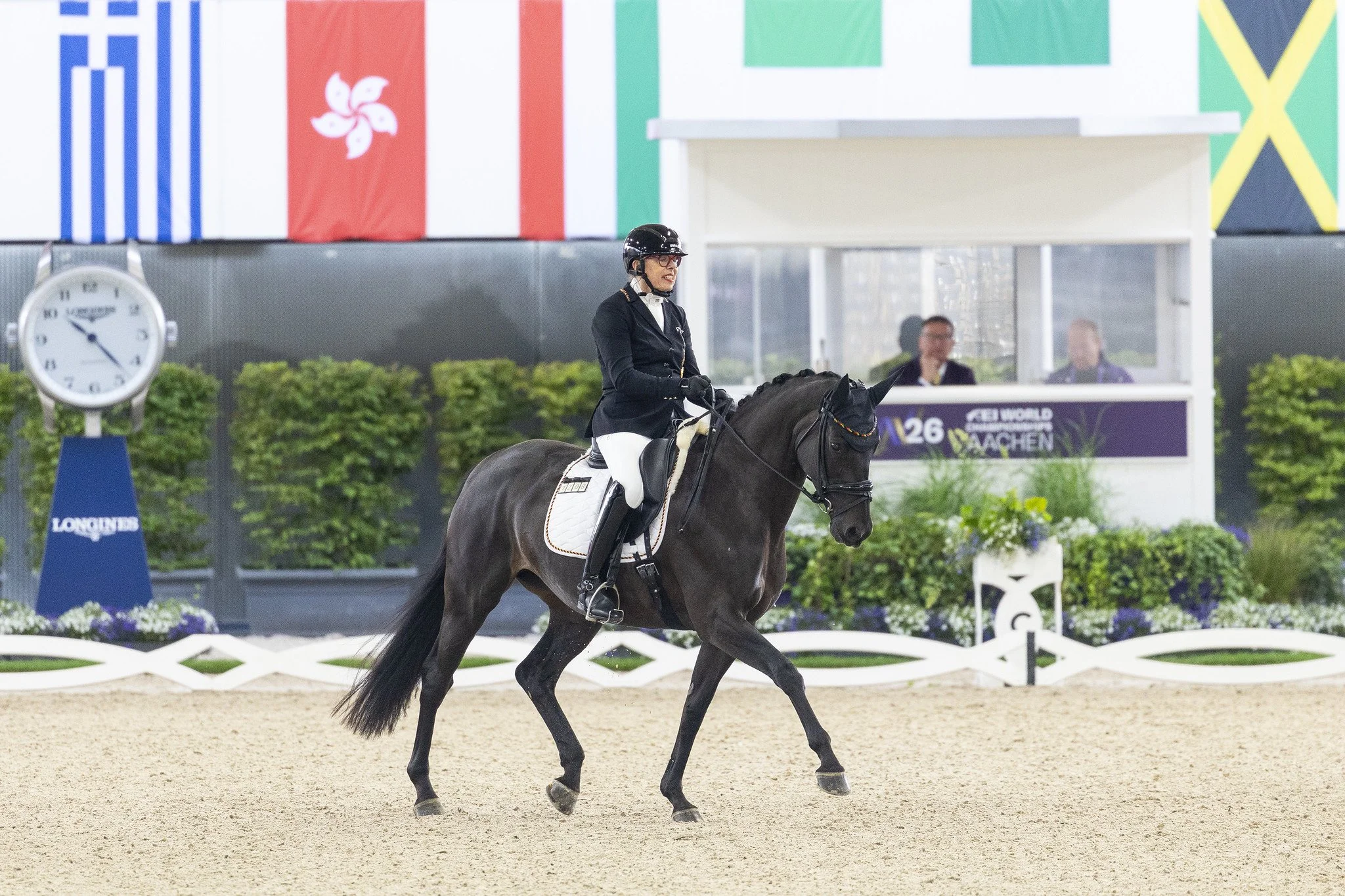
Heidemarie Dresing (GER) riding Poesie 143 during the FEI Para Dressage World Championship Grade II, in Aachen 2026. Image:© FEI/Leanjo de Koster
Riders are placed into one of five grades, numbered I to V, according to their functional ability. The classification is done by trained classifiers assessing what a rider can and cannot do in relation to riding, not according to medical diagnosis.
Grade I covers athletes with the most significant impairment of function. Grade V covers athletes with the least.
Crucially, the grade determines which test you ride. The tests are written so that each grade is asked for movements appropriate to the functional ability within it.
Broadly, Grade I tests are ridden in walk only. Grade II adds trot. Grade III is ridden in walk and trot. Grade IV introduces canter. Grade V includes canter, lateral work and flying changes, and at the top end looks closest to what a general audience recognises as dressage.
The FEI Para Dressage Rules are undergoing a full revision in 2026, with proposed final versions published on 6 November ahead of the General Assembly vote on 5 December, so some test content may change for 2027.
Within a grade, every rider rides the same test. A Grade I rider with one profile and a Grade I rider with another are judged against each other and against the same standard. That is the entire design principle: classification creates the fair field, and then the sport is judged normally.
The Judging
This is the part most people get wrong.
Para dressage is not judged leniently, separately or on a different scale. It uses the same system as able-bodied dressage: each movement is scored out of 10, in half marks, by a panel of judges positioned around the arena at C, E, B, H and M, with collective marks for the overall picture.
The judges are assessing the same qualities: rhythm, suppleness, contact, impulsion, straightness, collection, accuracy, and the harmony between horse and rider. A score of 75% in Grade I means the same thing as 75% in Grade V, which is why the leading scores across the grades at a championship sit in a similar range. At Aachen in August, Kate Shoemaker won the Grade IV Freestyle on 83.305% and Rixt van der Horst won Grade III on 83.120%.
What judges are not doing is making allowances. A rider who cannot use their legs is not scored generously for a transition; they are scored on the transition. The accommodation happens in classification and in compensating aids, not in the marking.
Compensating Aids
Riders may be approved to use equipment that allows them to communicate with the horse in ways their impairment would otherwise prevent. Depending on the rider's profile, that can include modified reins, connecting rein bars, rubber bands, adapted stirrups, specially built saddles, and the use of one or two whips in place of leg aids.
Every aid a rider uses is listed on their classification documents and checked. Using an unapproved aid is a rule breach, not an advantage.
Visually impaired riders compete with a caller, sometimes known as a commander: a person positioned around the arena who calls the letters so the rider knows where they are. Britain's Nicola Naylor competed at Aachen with her caller Julie Riches. The caller gives position, not instruction. A rider who is told where C is still has to ride the movement.
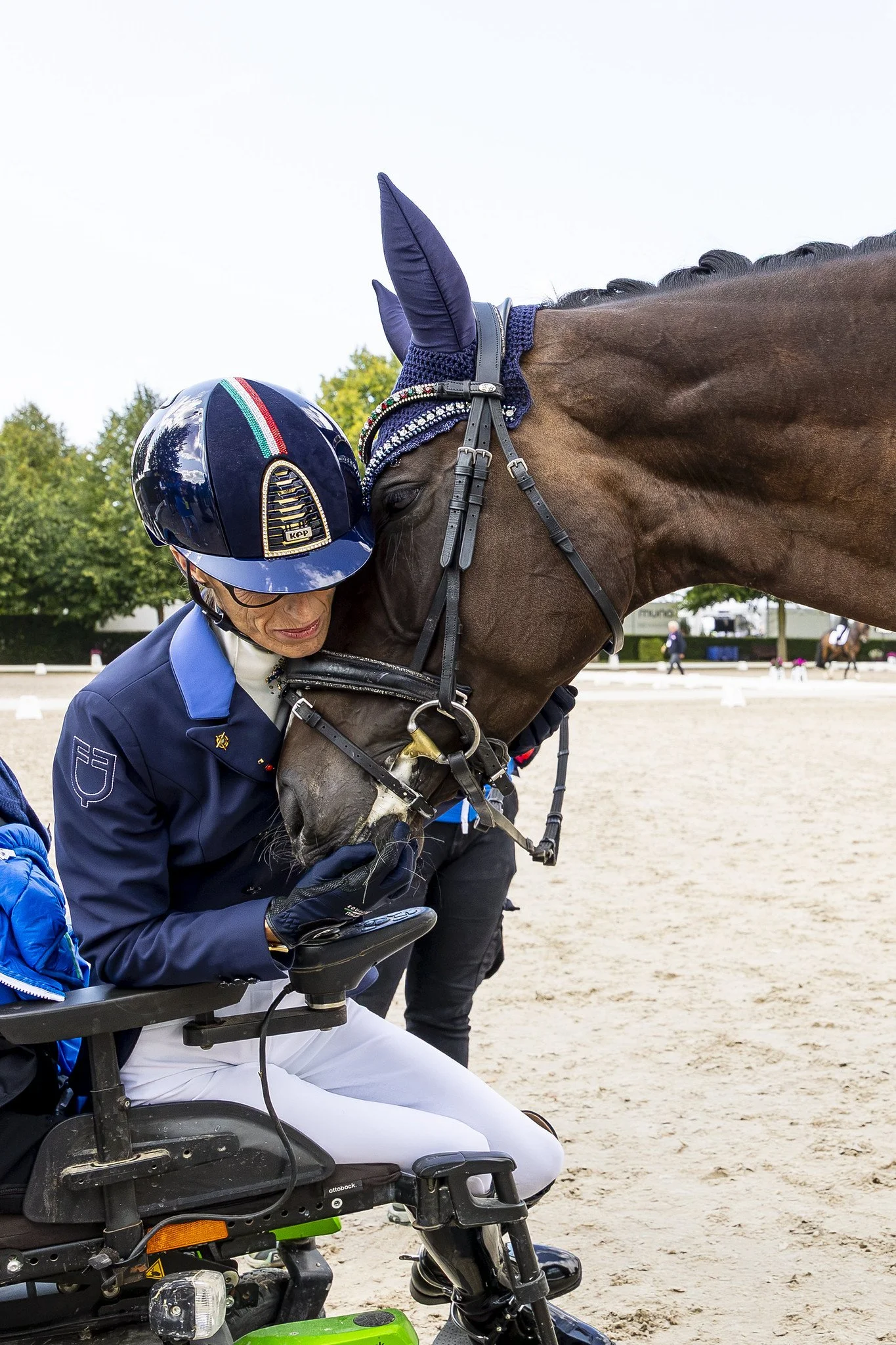
Sara Morganti (ITA) and Bond Girl during the FEI Para Dressage World Championship in Aachen 2026. Image: © FEI/Leanjo de Koster
The Championship Format
At a World Championship, the medals come in three sets.
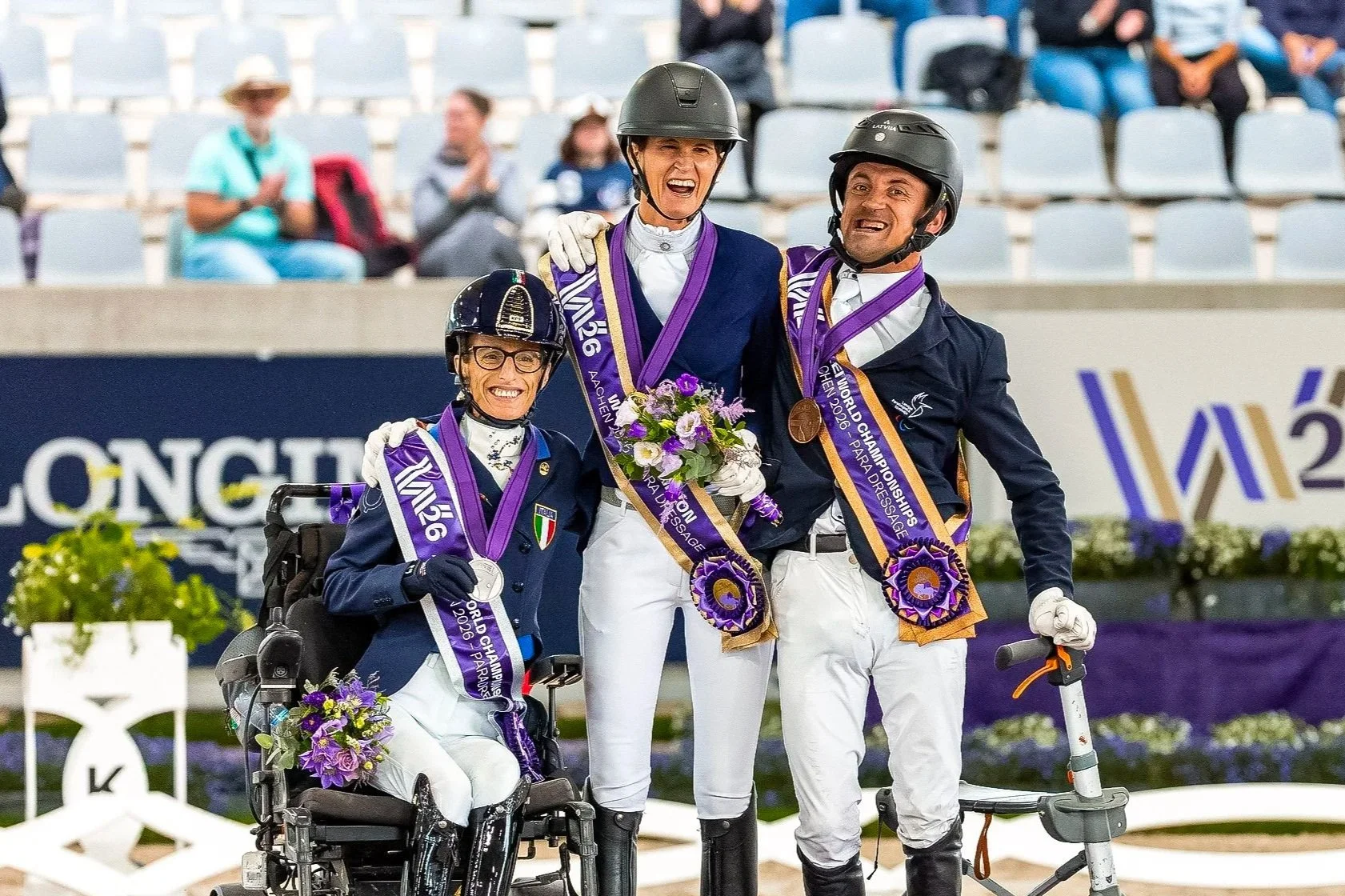
The Individual Final Grand Prix A decides the individual title in each of the five grades. At Aachen this ran across 19 and 20 August.
The Team Final Grand Prix B decides the team medals. Teams are made up of either three riders with three horses or four riders with four horses, and where there are four, only the three best scores count. At least one team member must be classified in Grade I, II or III, and no team may include more than two riders from the same grade.
That composition rule is the one worth understanding, because it shapes everything. It prevents a nation from building a team entirely from its strongest grade and forces federations to develop riders across the full range of impairment. A country with four brilliant Grade V riders cannot field them.
The Grand Prix Freestyle closes the championship. The top eight riders per grade from the Grand Prix A and B tests qualify, and ride to music of their own choosing, with the choreography scored for technical execution and artistic impression.
Across five grades, that produces eleven sets of medals at a World Championship.
What to Watch For
Three things will tell you whether you are watching a good test.
Regularity. In Grade I, where the whole test is walk, the quality of the walk is the competition. A four-beat walk with even, purposeful steps and a horse genuinely reaching into the contact is far harder to produce than it looks, and it is where the marks are won.
The transitions. In every grade, transitions between and within paces reveal whether the horse is truly in front of the rider's aids or being managed. A rider using compensating aids has fewer tools, which makes a clean, prompt transition more impressive, not less.
Stillness. The best para dressage riders look as though nothing is happening. The horse appears to be doing it on its own. That is the hardest thing in the discipline and the surest sign of a high score coming.
Why It Is Worth Watching
Para dressage carries the clearest version of the argument equestrian sport makes about itself, which is that the partnership between horse and rider can do something neither could do alone.
It is also, in competitive terms, a genuinely open discipline. The United States won the Aachen team title on a record score in August, having taken bronze at the same championship four years earlier. Sweden's Lena Malmström won her first championship gold. Britain, which dominated the sport for two decades, finished fifth.
Nothing about that was predictable four years ago, and nothing about Los Angeles in 2028 is predictable now.